The Mallock Machine
1933 · Simultaneous Equations · Work 653 of 1,871
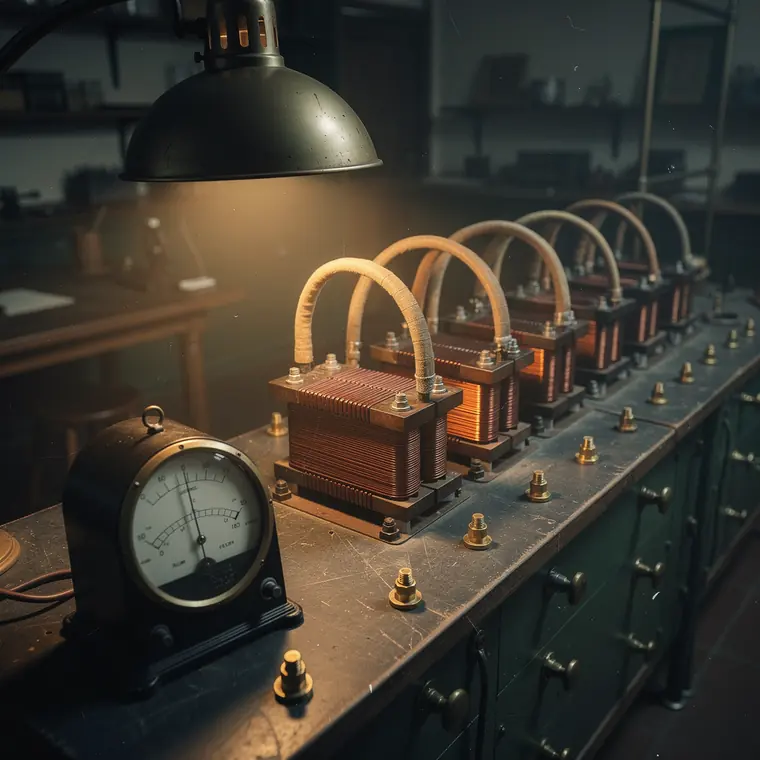
A bank of identical transformers standing in a row on a slate panel, each transformer a laminated iron core with wound coils, heavy insulated wiring looping between them in arcs, a galvanometer at one end of the panel with its needle resting at the centre of its scale, the scale a graduated arc with fine tick marks, the slate panel dark grey with polished brass terminal posts, the row of transformers stepping into depth, in a university engineering laboratory of the early 1930s, one shaded electric lamp lit above the galvanometer, the laboratory beyond dark.
- What it was used for
- The Mallock machine was an electrical calculator for systems of linear equations. R. R. M. Mallock designed it; the Cambridge Instrument Company built it in 1933. Sotheby's catalogue of the Erwin Tomash library, citing Haroon Ahmed, Cambridge Computing (2013), p. 24, says it could solve "up to six simultaneous linear algebraic equations", and "The only working model, built in 1933 by Cambridge Instrument Company, was eventually dismantled". It was used: in 1940 M. V. Wilkes, at the Mathematical Laboratory, published a method for integrating differential equations on it.
- What was new
- What the machine could do was solve a whole system of linear equations electrically. In 1940 Wilkes showed in the Mathematical Proceedings of the Cambridge Philosophical Society that this extends to pairs of second-order simultaneous linear differential equations in two unknowns, basing his method on one of Hartree's, and that "Any required degree of accuracy in the solution can be obtained". The barb is in a referee report for the Royal Society: on 5 April 1933 Sydney Chapman judged Mallock's paper good enough for the Proceedings but advised cutting it to about a third of its length and moving the technical parts to the Journal of Scientific Instruments.
What the sources leave open: The number of equations is disputed: the Tomash catalogue, citing Ahmed, says six; the Trumpington Local History Group gives six for a 1931 prototype and ten for the improved 1933 model. Mallock's own paper (Proc. Roy. Soc. A 140, 1933, pp. 457-483) could not be consulted, only Sydney Chapman's referee report on it; the machine's construction (coupled transformers in widely repeated accounts) is therefore unverified and left out.
Further reading
- Sotheby's, The Library of Erwin Tomash, Lot 709: Analog Computers, collection of eight papers or works (darin Mallock, An electrical calculating machine)
- Royal Society Archives, RR/50/44: Referee's report by Sydney Chapman on 'An electrical calculating machine' by R R M Mallock, 5 April 1933
- M. V. Wilkes, A method of solving second order simultaneous linear differential equations using the Mallock machine (Math. Proc. Camb. Phil. Soc. 36, 1940)
- Trumpington Local History Group: Notes for Rawlin Richard Maconchy Mallock