The Water Integrator
1936 · Hydraulic Computation · Work 654 of 1,871
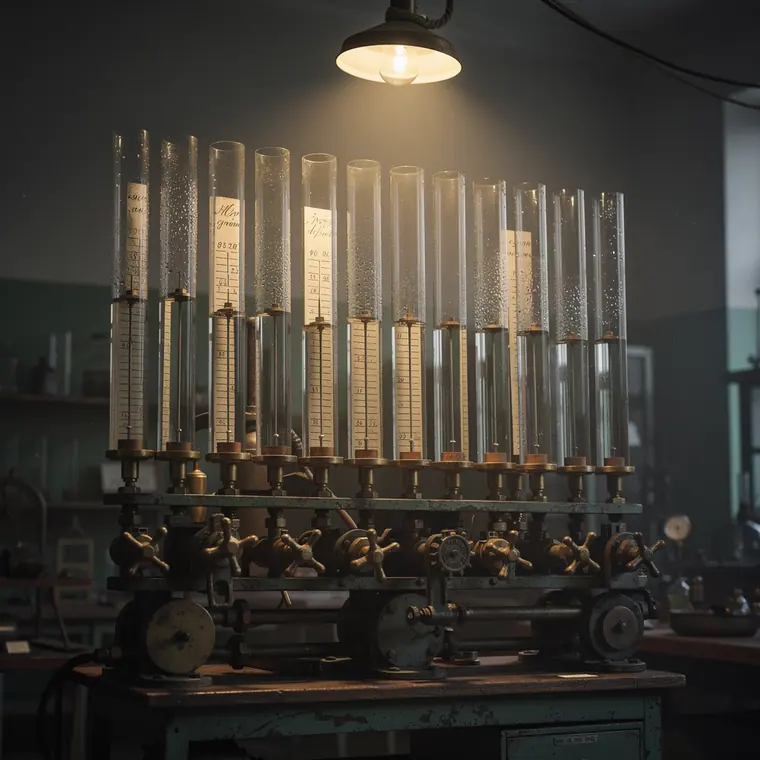
A wall of vertical glass tubes standing in a row joined at their bases by pipes fitted with brass taps, water standing at a different height in each tube, small floats with pointers riding on the surfaces against paper scales, each scale a strip with fine graduated tick marks, the water in the tubes catching the light, condensation on the glass, every object of 1936 make, in a Soviet engineering institute laboratory, one bare electric bulb on a cord above the tubes, the room beyond the wall of glass dark.
- What it was used for
- The water integrator was a calculating device made of vessels, pipes and taps. Water stood for heat: water levels in the vessels represented temperature differences from the air, the cross-sections of the vessels thermal capacities, and the resistance of the pipes thermal resistances. To find out how heat spreads through a structure or through the ground, you built the problem out of vessels, opened the taps and read the levels. Andrew Adamatzky dates these devices to 1936 in his survey and writes that both the Soviet and the American versions were designed to imitate heat transfer. On figures from the Polytechnic Museum in Moscow, which he quotes, about 150 hydraulic integrators were built in the USSR, some exported to Poland, the Czech Republic and China; a portable version was made for schools.
- What was new
- The device did not compute with numbers but with flow: the heat-conduction equation was not solved but reproduced as moving water, and the answer stood there as a water level. There is no single inventor: Adamatzky writes that hydraulic computing devices were invented simultaneously in the early 1930s in the USSR by Luk'yanov and in the USA by Moore. The barb is in the service life. These analogue machines did not vanish when electronic computers arrived: Adamatzky notes a Model No. 3 donated in 1956 by the Ryazan factory of analogue computers to the Moscow Polytechnic Institute, so a factory for analogue computers still existed when the first digital machines were already running.
What the sources leave open: Thinly sourced. Only one solid source, a survey that cites the Polytechnic Museum in Moscow for the production figures. A. D. Moore's paper on the "Hydrocal" (Industrial and Engineering Chemistry) was not retrievable. The often-repeated uses in permafrost and dam engineering could not be verified and are therefore left out.