The Phillips Machine
1949 · Hydraulic Economics · Work 655 of 1,871
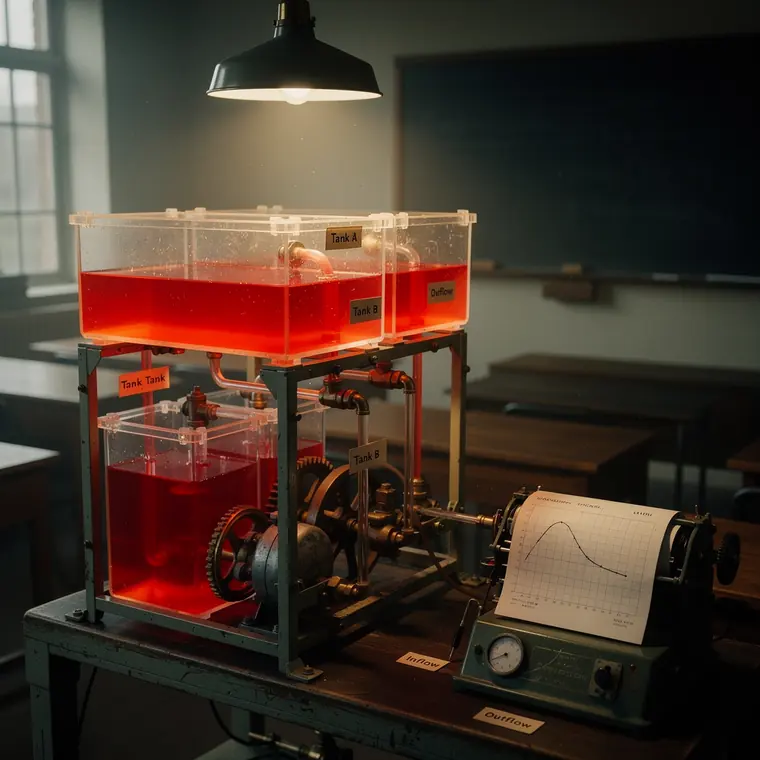
A transparent apparatus of perspex tanks, valves and channels through which coloured water circulates, tanks of different sizes set at different heights joined by clear pipes and sluices, a pump at the base returning the water to the top, the water dyed red, a pen at the side plotting the level of one tank on a sheet of ruled graph paper carrying a single drawn curve, the tank fronts plain, the frame painted, in a university lecture room of the late 1940s, one electric lamp lit above the tanks so the coloured water glows, the lecture room beyond dark.
- What it was used for
- The Phillips machine was a hydraulic model of a national economy: water running through pipes, valves, tanks and pumps, standing for the flow of money. The Science Museum Group catalogue records that it was conceived by Bill Phillips (1914-1975), a New Zealand-born engineer turned economist: "He designed the machine to demonstrate in a visual way the circular flow of money within the economy." White Ellerton Limited built it in 1949. The museum's machine is two metres high, 1.63 metres wide and weighs 144 kilograms. It was used as a teaching aid at the London School of Economics and, the museum says, ran there until May 1992.
- What was new
- What the machine could do was make a macroeconomic model both visible and time-dependent: open a tap and the effect ran through the whole system as water levels, instead of sitting in equations. Hydraulic analogue computers had already existed for more than a decade, for instance the water integrators of the 1930s. The barb is the number built against the length of service: the museum counts only about fourteen machines - and one of them, a teaching aid, still ran until May 1992, the museum says.
What the sources leave open: The Science Museum Group catalogue record does not explain the mechanism, gives no price and does not say whether the machine was the first of its kind; water, pipes, valves and tanks are described in the museum's story "How does the economy work?". The figure of about fourteen machines is explicitly an approximation there ("Approximately fourteen machines were built").