The Network Analyser
1929 · Power System Model · Work 656 of 1,871
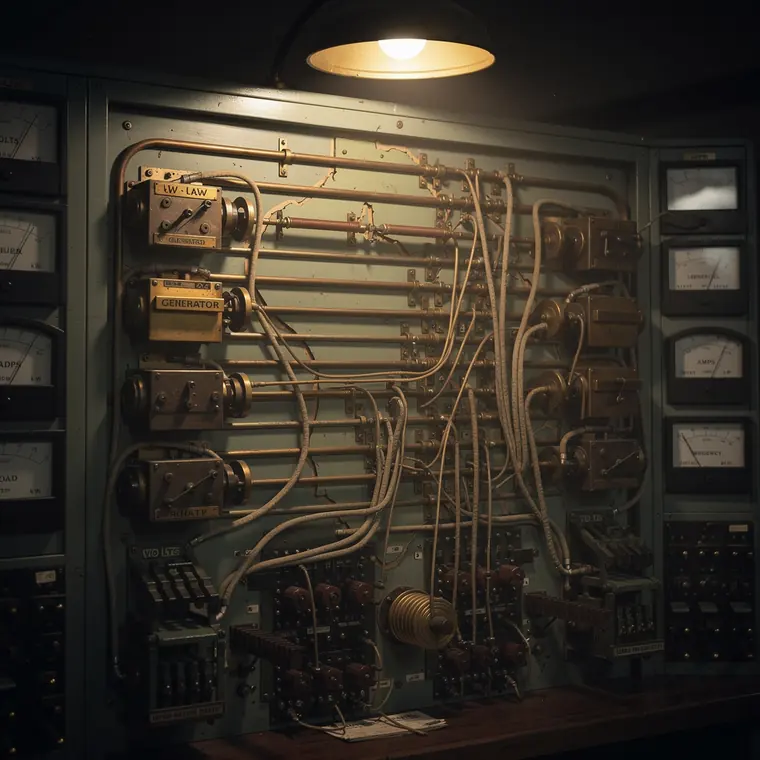
A large patch panel representing a power grid in miniature, a wall of plain panels carrying rows of adjustable resistors and inductors standing for transmission lines, generator units on one side and load units on the other, patch cords laid across the panel in the shape of the country's geography, banks of meters with graduated dials and fine tick marks along the top, in a university electrical engineering laboratory of 1929, one row of overhead lamps lit above the panel, the laboratory beyond dark.
- What it was used for
- The network analyser was a whole power grid in miniature, filling a laboratory room: lines as coils and resistors, generators as adjustable voltage sources. Power engineers reproduced their real network in it and measured what a short circuit, a change of load or a new line would do. Aristotle Tympas cites the paper by Hazen, Schurig and Gardner on "The MIT Network Analyzer" and writes that General Electric, with its MIT partners, had such a machine, ceremoniously presented at MIT by 1930. General Electric rented out its own A-C network analyser in Schenectady: on a 1945 GE Monogram report Tympas quotes, more than a hundred companies rented it over seven years for more than three hundred investigations. A 1944 Westinghouse piece gives the comparison: two three-man crews working for months with adding machines on a railway electrification, "a monumental task and utterly hopeless".
- What was new
- What the machine could do was measure network problems rather than calculate them. It was an alternating-current calculating board, offered as the answer to "lengthy and usually impracticable mathematical calculations". The barb is the promise it did not keep. Tympas's article is titled "Perpetually Laborious" and argues that the analyser did not abolish computing labour: it needed skilled staff - in 1940s pictures Tympas describes, women set up the computing units while men sat at the control desks - and each generation of machine was replaced by the next, so the shortage of computing labour persisted. A 1935 Commonwealth Edison report, by contrast, claimed savings of approximately eight times its installed cost in two years of operation.
What the sources leave open: The date of the founding paper varies: Tympas calls it a 1929 AIEE paper, while the IEEE Computer Society's Pioneers page lists "The MIT Network Analyzer, Design and Application to Power System Problems" by Hazen, Schurig and Gardner as AIEE Trans. vol. 49, July 1930, pp. 1102-1113. Neither source gives production numbers. Tympas dates the Commonwealth Edison report to 1935 in his text but cites an Electrical World article of 23 November 1945 for it.