The Soap Film Model
1930 · Analogue Solution · Work 657 of 1,871
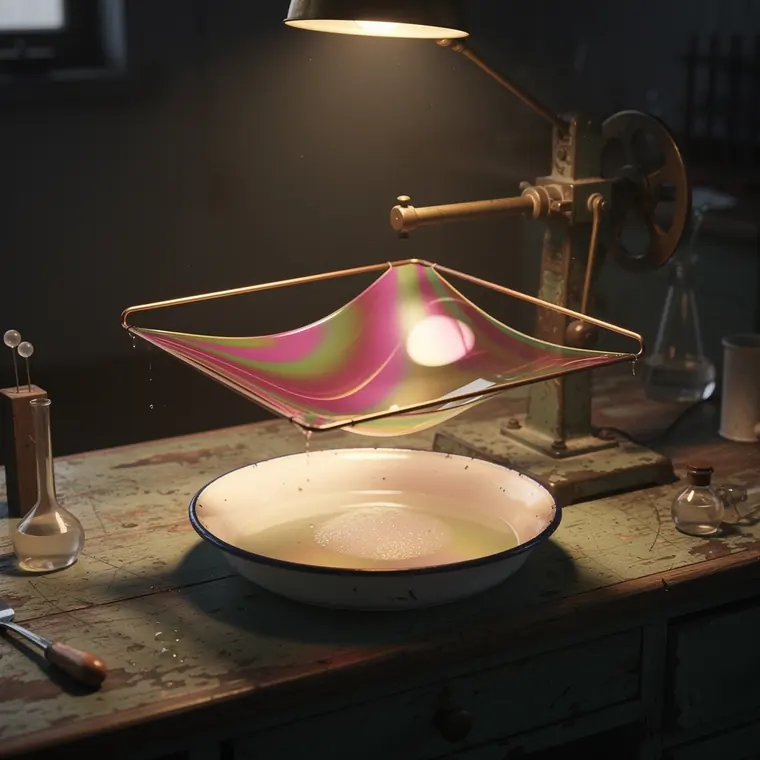
A wire frame dipped and lifted so a soap film spans it, the film taking by itself the shape that solves the equation, a smooth saddle surface stretched between the bent wire edges, interference colours banding across the surface in bands of magenta, green and gold, the frame held in a clamp above a dish of soap solution on a laboratory bench, in a physics laboratory around 1930, a single lamp lit close to the film so the colours flare, the bench and room beyond dark.
- What it was used for
- A soap film stretched over a hole in a plate was a calculating device in the engineering laboratory. The reason: the film takes up by itself the shape described by a particular equation, and the same equation describes the torsion of a shaft. Cut the hole to the outline of a cross-section and the height of the film corresponds to the stress function, its slope to the shear stress - so you measured what you could not calculate. Writing in Proceedings of the Royal Society A in 2019, Laura Galuppi and Gianni Royer-Carfagni note that Barré de Saint-Venant solved the torsion problem for simply connected sections in 1856, and call this the "membrane or soap-film analogy, ingenuously proposed by Prandtl in 1903". The practical work is A. A. Griffith and G. I. Taylor, "The use of soap films in solving torsion problems" (Proceedings of the Institution of Mechanical Engineers, 1917), with a sequel on hollow shafts in 1918.
- What was new
- What the soap film could do was handle cross-sections for which no formula existed - keys, grooves, hollow sections, re-entrant corners where the stress shoots up. There was no closed calculation for those; a film and a lamp were enough. The idea is set out by Prandtl in 1903, and as early as 1906 Hugo Anthes took his doctorate under Prandtl in Hanover with an "experimental method for determining the stress distribution in the torsion of prismatic bars". Griffith and Taylor worked it up in 1917 and 1918 into a measuring method with its own apparatus, applied among other things to aircraft spars and hollow shafts. The barb: other analogies soon appeared alongside it, electrical ones "proposed circa 1925" according to the chapter's abstract. The reference list of the chapter by Ajovalasit, Nigrelli, Pitarresi and Virzi Mariotti lists, for torsion, electrical analogies by Biezeno and Koch (1933), Cranz (1933) and Thum and Bautz (1934), and a hydrodynamic analogy by Den Hartog and McGivern (1935).
What the sources leave open: Thin. Prandtl's 1903 paper and Anthes's 1906 dissertation were not consulted, only their bibliographic details; the title does not say whether Anthes used soap films. Griffith and Taylor (1917) describe the apparatus and its accuracy. The year 1930 could not be tied to any single device; all that is documented is that the method was in use at that period.
Further reading
- Laura Galuppi, Gianni Royer-Carfagni, Membrane analogy for multi-material bars under torsion (Proc. R. Soc. A 475:20190124, 2019)
- Determination of Torsional Stresses in Shafts: From Physical Analogies to Mathematical Models (Springer, Kapitelangaben und Literaturverzeichnis)
- A. A. Griffith, G. I. Taylor, The Use of Soap Films in Solving Torsion Problems (Proc. IMechE 1917, 755ff.)
- Mathematics Genealogy Project, Hugo Anthes