The Dumaresq
1902 · Rate Calculation · Work 659 of 1,871
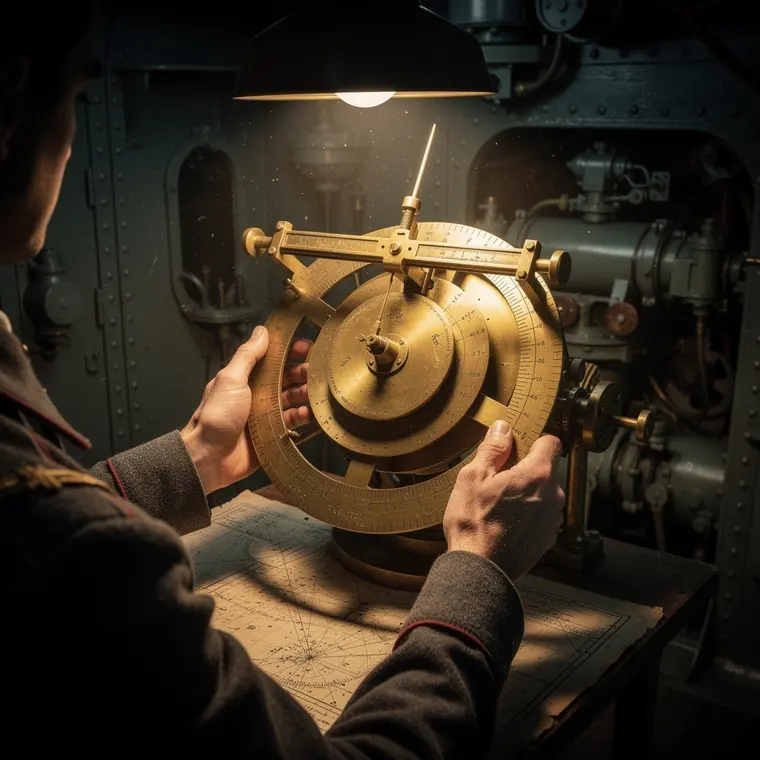
A hand-held brass instrument of concentric rotating plates, the plates graduated with fine radial tick marks for speed and bearing, a sliding bar across the top carrying a small pointer, the brass sea-worn at the edges and dulled with handling, held in the hands of an anonymous rating seen from behind, in the gun control position of a warship at dusk, grey steel plating around, one shaded lamp above the instrument throwing its cone of light on the plates, the rest of the position in shadow.
- What it was used for
- The dumaresq was a hand calculator of the Royal Navy for the basic problem of a sea action: two ships are moving, and the range between them changes continuously. It is named after its inventor, Lieutenant John Saumarez Dumaresq; the Dreadnought Project describes it as "designed and patented by Lieutenant John Saumarez Dumaresq between 1902 and 1904" and names Elliott Brothers as the first maker. It was worked like this: set your own speed and course, estimate the enemy's speed and course, turn the axes onto the bearing - and read off the rate of change of range and the enemy's speed across. Writing for the H.M.S. Hood Association, William Schleihauf says the device took own speed and the enemy's bearing, course and speed, and: "With these values, the Dumaresq would compute the rate of change of range."
- What was new
- What the device could do was more than compute in one direction: it could be run backwards. In the so-called cross-cut mode you set range rate and speed-across and read off what course and speed the enemy must have - reasoning from the observed effect back to the cause. Later marks did more of the work: the Dreadnought Project records that the Mark VI held the set enemy inclination automatically while your own ship turned. The barb is longevity. According to the 1915 Manual of Gunnery cited there, the Mark III was an "old pattern", and the same page notes it as "practically obsolete" in 1920; the Mark XI for armed merchant ships was so spare that own speed was fixed at 12 knots. The same source says the Mark VIII was still used aloft after the Second World War.
What the sources leave open: Production numbers and dimensions are not documented; the Dreadnought Project gives none. Its statements about the individual marks rest on service manuals (Manual of Gunnery vol. III, 1915 and 1920; B.R. 1534, 1946) and on Schleihauf's article "The Dumaresq and the Dreyer" (Warship International 2001) and John Brooks, which were not consulted here in the original.