The Argo Clock
1912 · Course Prediction · Work 661 of 1,871
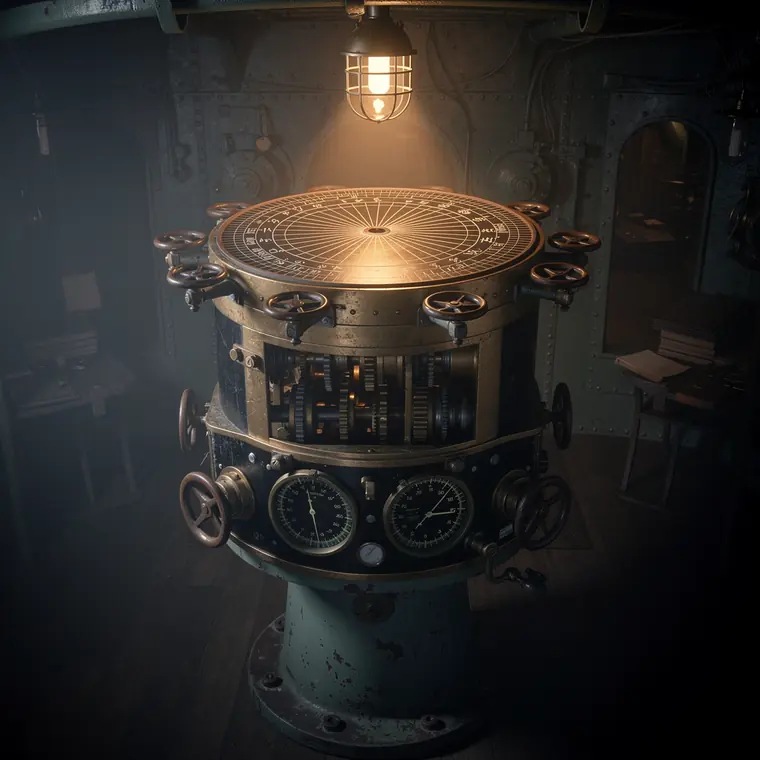
A heavy cylindrical instrument on a pedestal with a compass rose set into its top, the rose graduated with fine radial tick marks, handwheels around its waist, dials on its face with fine tick marks showing a continuously updated range, the mechanism inside turning steadily, the case brass and black enamelled steel, in the transmitting station of a warship, riveted bulkheads, one caged electric lamp above the instrument, the compartment beyond dark.
- What it was used for
- The Argo clock was the fire-control computer of the inventor and entrepreneur Arthur Pollen, who offered the Royal Navy a complete gunnery system. It combined a dumaresq linkage with integrators: from range rate and bearing rate it carried the enemy's range and bearing forward continuously, so that both were kept up to date automatically once correctly set. According to the Dreadnought Project, citing John Brooks, it had no input for a change of own course: a STEADY/TURNING lever disconnected the bearing clock from the bearing dial so the bearing could be set by hand during a turn, while the clock kept the enemy's inclination, so the range stayed right. The Mark IV was tried in the Mark II Dreyer table in place of the dumaresq and Dreyer clock.
- What was new
- What the Argo clock did differently was compute range and bearing in one operation. The Jutland Centenary site puts the contrast this way: Pollen calculated both simultaneously, Dreyer plotted them separately. Who had the underlying idea first is unresolved; the same source calls Pollen only "probably" the inventor and says much of his work was then copied by Captain Dreyer. The barb is the number: "Only six Argo clocks were on British ships at Jutland" - listed as Orion, Princess Royal, Queen Mary, King George V, Ajax and Centurion. On the same account the Admiralty had been persuaded by the lower price of the Dreyer version, so the Argo clock went into the war's greatest fleet action aboard six ships.
What the sources leave open: Nothing verifiable was found on order quantities, prices or the end of Pollen's contract with the Admiralty; the Jutland site speaks only of the "lower price tag" without naming prices. The Dreadnought Project's main Argo clock page is brief; it records only limited adoption within the Mark II Dreyer table and that large orders never came.