The Kerrison Predictor
1940 · Anti-Aircraft Prediction · Work 662 of 1,871
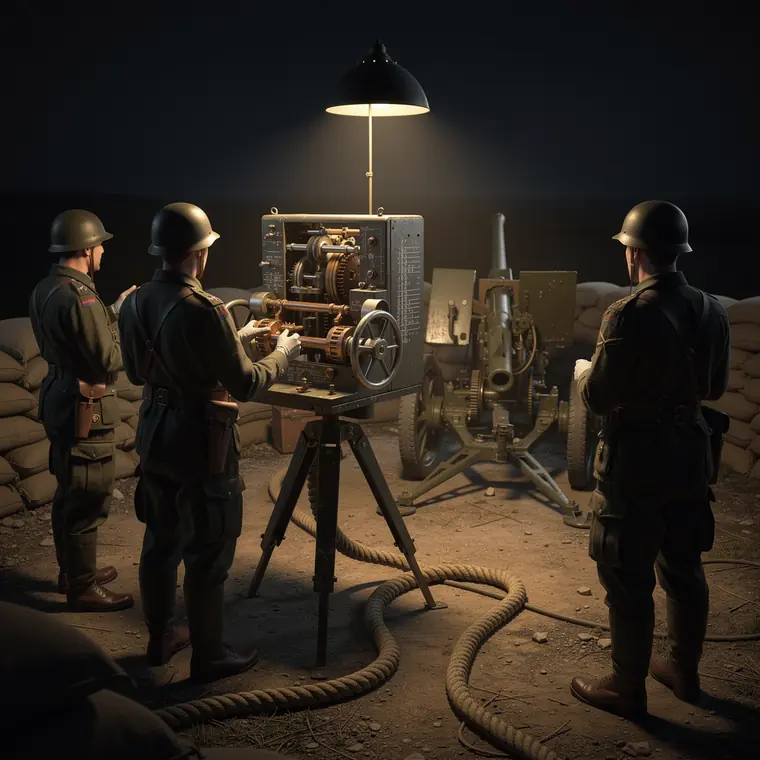
A compact predictor box on a tripod standing beside a gun mounting, a plain steel case with handwheels and graduated dials with fine tick marks on its sides, a thick cable running across the ground to the gun, anonymous operators standing close around it seen from behind with their hands on the tracking handwheels, the light anti-aircraft gun on its wheeled carriage beyond, sandbags around the position, every object of wartime 1940 make, on a gun site at night, one shaded lamp on the predictor throwing its cone of light on the dials, the field beyond dark.
- What it was used for
- The Kerrison Predictor was a calculating device for light anti-aircraft fire. The crew pointed it at the aircraft; the device worked out the aim-off and drove the 40 mm Bofors gun itself through power controls, instead of calling a number to the layer. Its official name was "Predictor No. 3": in 1940 the War Office issued in London the "Manual of anti-aircraft defence. Vol. I : gunnery. Part I, pamphlet no. 16 : predictor no. 3 and the power controlled 40-mm. L.A.A. gun 1940", marked "not to be published" on the cover and notified in Army Council Instructions of 11 September 1940 (Imperial War Museums, LBY WO 1317). What it looked like in the field is shown by an Australian War Memorial photograph of 1942 from Crawley Bay near Perth: "A NO 3, OR KERRISON PREDICTOR WHICH CONTROLLED A BOFORS 40MM ANTI AIRCRAFT GUN OF 8 BATTERY", with two men of 8 Battery in the picture, 2/3rd Light Anti-Aircraft Regiment, one of them Gunner A F Jakins.
- What was new
- What mattered was the coupling: the device did not merely compute, it laid the gun. The barb is in why it prevailed. David A. Mindell writes in IEEE Control Systems (April 1995) that the US Army adopted the Kerrison as an English system under the designation M5, and that it was "less accurate than the M7 but easier to manufacture". Sperry redesigned it for high-volume production in 1940 and handed manufacturing to Singer and Delco in 1941. Of Sperry's own, more accurate directors Mindell judges that they could not negotiate the fine line between performance and production, and that the difficulty of making their ballistic cams was a major limitation on their usefulness. The coarser machine was built because it could be built.
What the sources leave open: Weight, parts count, crew size and production numbers remain open: the figures findable online (such as "over 1,000 precision parts", "over 500 lb", "three aimers") come from copies of Wikipedia and are therefore left out. The 1940 manual could only be seen as a catalogue record, not in its content.
Further reading
- Imperial War Museums, Manual of anti-aircraft defence. Vol. I: gunnery. Part I, pamphlet no. 16: predictor no. 3 and the power controlled 40-mm. L.A.A. gun 1940 (War Office, LBY WO 1317)
- Australian War Memorial, Foto P01260.020, Perth 1942 (No 3 or Kerrison Predictor, 2/3rd Light Anti-Aircraft Regiment)
- David A. Mindell, Anti-Aircraft Fire Control and the Development of Integrated Systems at Sperry, 1925-1940 (IEEE Control Systems, April 1995)