Mark I Fire Control Computer
1943 · Naval Fire Control · Work 663 of 1,871
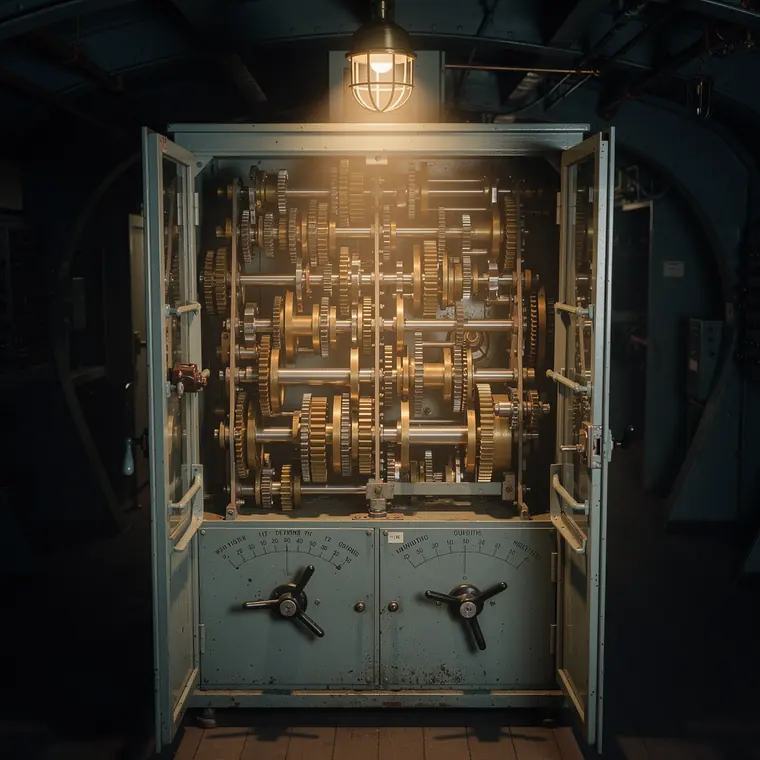
A cabinet the size of a wardrobe standing open, inside it a dense three-dimensional lattice of shafts, cams and differentials machined to a jeweller's tolerance, layers of bright steel shafts crossing at right angles, brass gears, barrel cams with their followers, the lattice staggered into depth to the back of the cabinet, graduated dials with fine tick marks and handcranks on the front panels, the panels plain grey, in the plotting room of a warship, riveted bulkheads, one caged lamp above the open cabinet, the compartment beyond dark.
- What it was used for
- The Computer Mark 1 was the US Navy's fire-control computer: a cabinet full of gears, cams and integrators, installed in the plotting room below decks. Bureau of Ordnance publication OP-1064 of 29 June 1945 calls it "the mechanical brain" of the Gun Director Mark 37 System, serving both anti-aircraft and surface fire. From the data of the director, the Stable Element and the ship course and speed indicators it produced continuously the predicted target position, advance range, sight angle, sight deflection and fuze setting order. The same publication divides it into eight groups of mechanisms, among them the Deck Tilt Group, Relative Motion Group, Integrator Group and Prediction Section.
- What was new
- What it achieved shows in its layout: it took the ship's own attitude into the calculation. The Deck Tilt Group and the data from the Stable Element made it possible to compute out roll and pitch, so the angles it put out held for a moving deck; and one set of mechanisms served both anti-aircraft and surface targets. The barb is duration: the basic publication is dated 29 June 1945, after the war in Europe; the maintenance volume OP-1064A followed in 1947, and an addendum of 14 September 1951 covered the Computer Mark 1A. The mechanical computer was thus still being documented officially six years after the war, while the first electronic computers were long at work.
What the sources leave open: Production numbers and total parts count are not documented. Weight and price, however, are given in OP-1064 itself: "The Computer Mark 1 weighs about 3125 lbs." and "The finished instrument costs about $75,000." Only a reprint of OP-1064 on a private collector's site was consulted, not the original. No source confirms the year 1943; OP-1064 is from 1945 and the Mark 1A addendum from 1951.