The Norden Bombsight
1942 · Bombing Computer · Work 664 of 1,871
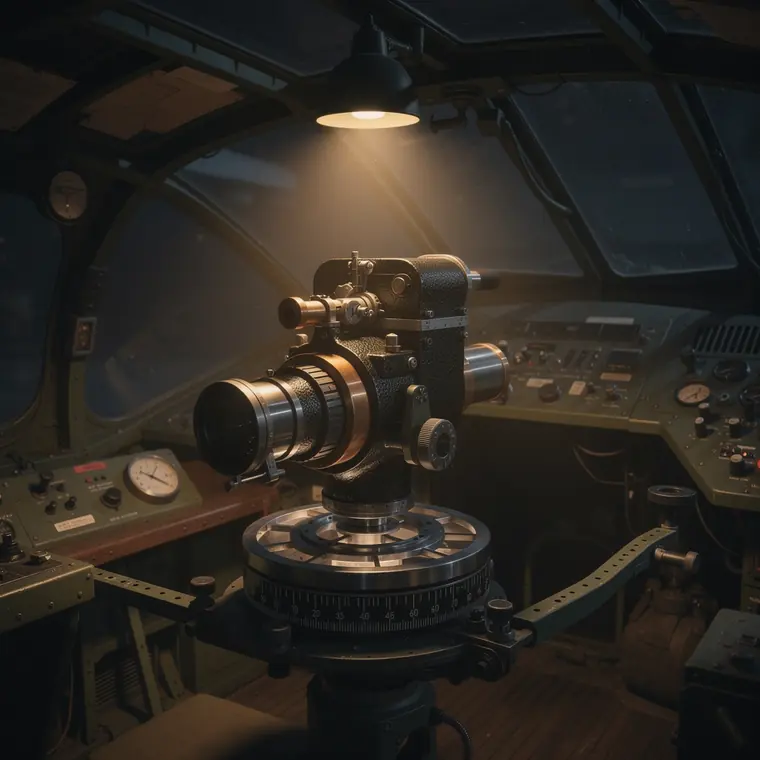
A stabilised optical head on a gyro platform, a small telescope pointing down through an opening in the floor, knurled setting knobs around its base, a graduated dial with fine radial tick marks on its side, the head black crackle finish with bright steel gimbal rings, mounted at the bombardier's station in the glazed nose of a bomber, the plexiglass nose panels and framing around it, every object of wartime 1942 make, at night, one small shaded lamp above the sight throwing its cone of light on the knobs, the nose compartment beyond dark.
- What it was used for
- The Norden bombsight was the computer in the nose of American bombers: a telescope on a gyro-stabilised mount with a mechanical computing unit beneath it. According to the fact sheet of the National Museum of the United States Air Force, the bombardier entered wind direction, airspeed and altitude into the analogue computer, which calculated wind drift and gave the correct aim point. A gyroscope held the telescope level at high altitude, and linked to the Sperry C-1 autopilot the sight gave, on the museum's account, unprecedented accuracy. Carl Norden developed it for the US Navy; the Army Air Corps received its first in 1932. Because production lagged, the Army Air Forces flew the less accurate Sperry S-1 until 1943, when enough Norden sights were available.
- What was new
- What the sight could do was work out the aim point from wind, airspeed and altitude, and coupled with the C-1 autopilot, according to the museum's fact sheet on the C-1, the bombardier as well as the pilot could control the aircraft. The museum calls its accuracy "unmatched by any other nation at the time", and also highly classified. The barb stands in the same text: newspapers claimed it could "drop a bomb into a pickle barrel". On the Schweinfurt raid of October 1943 more than 250 B-17s attacked, and only about one bomb in ten fell within 500 feet of the target; 60 bombers and 600 airmen were lost, and the plant was not completely destroyed.
What the sources leave open: The main source is the National Museum of the United States Air Force fact sheet on the Norden sight; added is the museum's fact sheet on the autopilot, which calls it the Honeywell C-1, whereas the Norden fact sheet says Sperry C-1. The widely repeated figures for numbers and price (72,000 units, $8,800 each) could be found only in copies of Wikipedia, including a museum handout, and are therefore left out.