The Firing Table Room
1943 · Ballistic Computation · Work 665 of 1,871
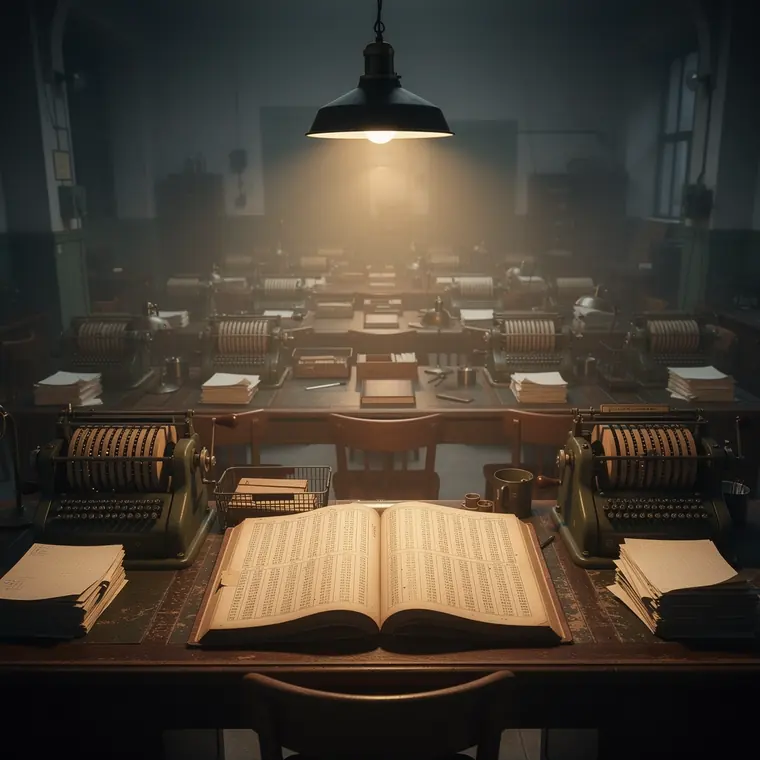
A large room of desks with mechanical desk calculators, rows of desks stepping away into depth, at each place a hand-cranked calculator and sheets of ruled paper, anonymous women seen from behind at the calculators working, a finished bound table lying open on the checking desk in the foreground, its pages closely set columns of small figures seen at a shallow angle so the digits blur into texture, every object of wartime 1943 make, in a ballistics research laboratory, one row of pendant lamps with only the nearest lit over the checking desk, the far desks fading into darkness.
- What it was used for
- The computing room of the Ballistic Research Laboratory at Aberdeen produced firing tables: tables giving the gunner, for every range, the elevation required. Without them a gun was almost useless. According to section 4.3 of the account "Bit by Bit", the laboratory computed roughly two to four thousand trajectories for each pairing of gun and shell, and that covered only altitude and range. There, a computer at a desk calculating machine needed about three days per trajectory; in the volume "50 Years of Army Computing" Thomas J. Bergin gives about 20 hours for a trajectory with a 60-second time of flight. The differential analyzer managed one in 15 to 30 minutes, plus one or two hours of setting up per table. The laboratory trained about a hundred computers at Aberdeen and had a hundred more recruited through the Moore School.
- What was new
- What was new here was not a device but a chain: the same trajectory was computed by hand, on the differential analyzer, and from 1945 on ENIAC, which Bergin says managed it in about 30 seconds, "about half the time that the shell would be in the air". The room also shows what "computer" then meant: at the 1996 symposium Herman Goldstine said that "people" in those days meant women, because the men had all been taken into the draft; Harry Reed spoke of something like a hundred and some people pushing hand calculators. The barb is the backlog that remained despite the machinery: by 1941, Bergin writes, firing-table production was far behind; for 1943 "Bit by Bit" calls the laboratory "dangerously behind schedule"; and the machine built at Aberdeen in 1935 could not keep up with the Army's needs. Between 1 February and 30 June 1945 it computed 1560 trajectories for ten firing tables.
What the sources leave open: The sources differ on the time per trajectory by hand: "Bit by Bit" says about three days, Bergin about 20 hours for a 60-second trajectory, and Bergin himself notes his figures come from several sources. Both are therefore given in the text. The author and book title of the "Bit by Bit" account are not named on the page consulted.