The Crab
1935 · Course Plotter · Work 667 of 1,871
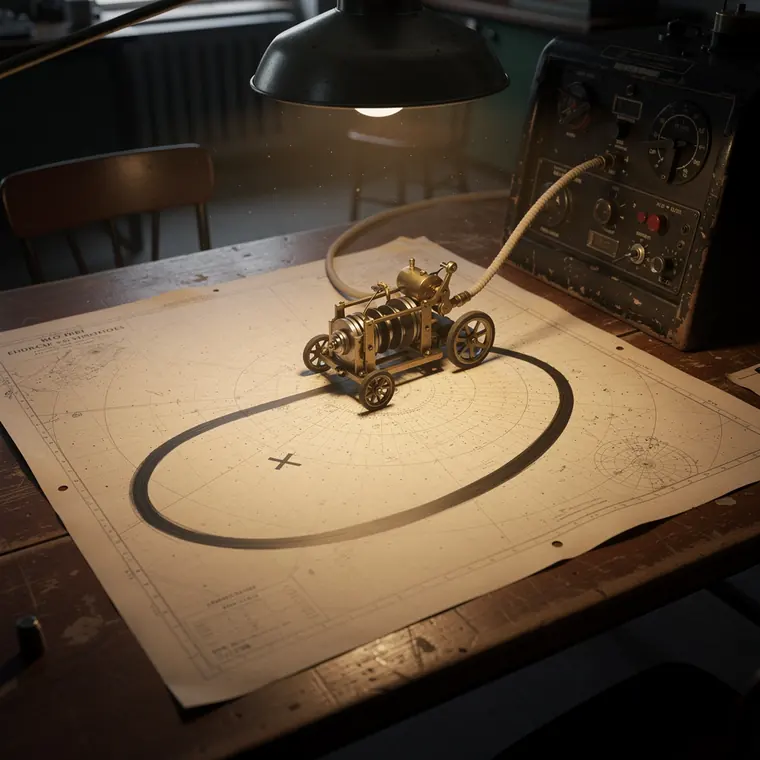
A small three-wheeled plotting device crawling across a paper chart, its inked wheel trailing a single line behind it in a wide curve, the chart plain paper marked with a small cross at the beacon position, the device a little metal carriage with a pen holder and a cable running back to the trainer, the table top plain, in a flying school room of the mid 1930s beside the trainer, one lamp lit over the chart, the room beyond dark.
- What it was used for
- The Crab was the course recorder on the instructor's desk beside a Link Trainer. It was a small carriage that ran across a scale map and drew the track with an inked wheel, recording the course a pupil flew inside the closed box on instruments alone. Its motion came from an electromechanical wind drift computer in the base of the trainer. That unit combined the pupil's control inputs with the settings the instructor dialled in, namely wind speed, wind direction and turbulence, and passed the result to the carriage through synchronous motors. The instructor sat at the desk, gave orders by radio and read off the ink line whether the pupil had held his course. The Army Air Corps bought six Link trainers in 1934 and the Japanese Navy became the second customer in 1935. By the end of the war Link had delivered, according to the MAPS Air Museum, 6,271 machines to the Army and 1,045 to the Navy, and they stood in 35 countries, among them Germany, Japan and the Soviet Union.
- What was new
- What was new was not the training box but the fact that a pupil's performance could be measured afterwards. The Crab turned it into a line on paper, and it did so including a wind that did not exist: the computer in the base continuously derived a position over ground from heading, airspeed and the wind the instructor had set. The instructor could therefore set a repeatable task and compare two pupils under identical conditions.
What the sources leave open: The description of the Crab with tracer wheel, ink roller, wind drift computer and Telechron motors comes from the Military Aviation Museum and refers to a restored Link C-3 which that museum dates to around 1941. For 1935 the sources record only the Japanese Navy as second customer, no event concerning the recorder. The MAPS Air Museum calls the same device a bug in one place and a crab in another. The sources give no date for the recorder itself.