The Autopilot Amplifier
1941 · Feedback Control · Work 668 of 1,871
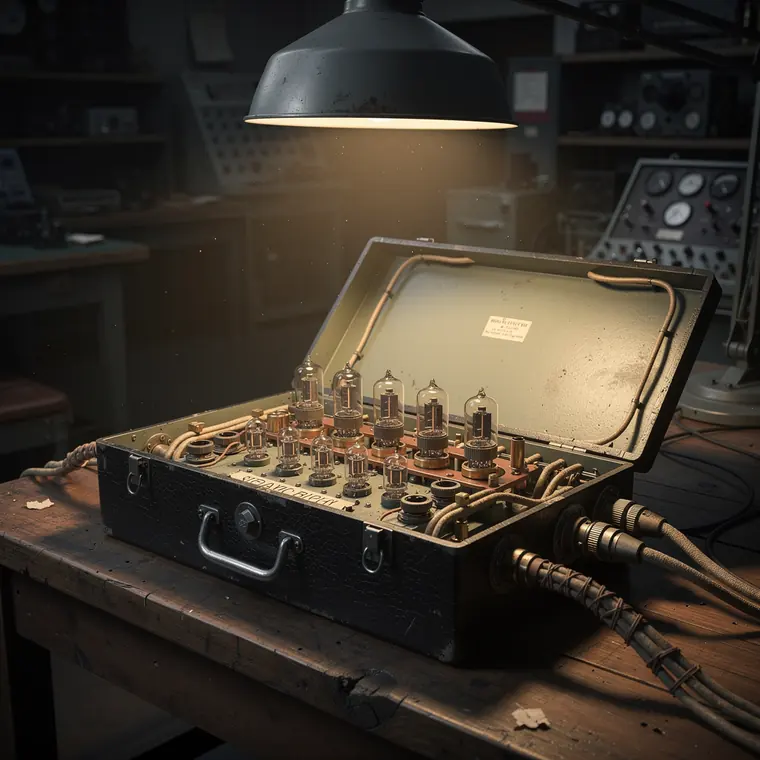
An open aircraft equipment box of vacuum tubes and precision potentiometers, glass tubes standing in a row in their sockets, wirewound potentiometers with knurled shafts, gyro leads entering at one end through a multi-pin connector and servo leads leaving at the other, wire lacing throughout binding the harness in neat bundles, the box black crackle finish with its lid set aside, on a workshop bench, in an aircraft instrument shop of the late 1930s, one bench lamp lit over the open box, the shop beyond dark.
- What it was used for
- The electronic amplifier was the computing and driving element of the Minneapolis-Honeywell C-1 autopilot. It picked up the tiny voltages the gyros produced when the aircraft drifted out of attitude, amplified them and used them to drive the servos on elevator, rudder and ailerons. Two gyros supplied the measurements: the flight gyro near the centre of gravity for roll and pitch, and the directional gyro in the bombsight stabiliser for yaw. The system was fitted in the heavy bombers B-17, B-24 and B-29. Together with the Norden bombsight it provided the steady platform that accurate bombing from high altitude required, and the bombardier could steer the aircraft through the sight itself. The Minnesota Inventors Hall of Fame states that over 30,000 bombers carried this equipment. The Commemorative Air Force Minnesota Wing writes that the system also flew in the Enola Gay and in Bockscar.
- What was new
- What was new was that the control loop amplified electronically instead of transmitting mechanically or hydraulically. Willis Gille, an engineer at a maker of heating controls, hit on the idea in 1941 of applying the principles of electronic temperature control to the automatic control of flight. The Minnesota Inventors Hall of Fame calls the result the aircraft industry's first electronic autopilot. Development of a three-axis unit began in mid-May 1941 and equipment for bombers went to the military in early December 1941. Gille later held more than 85 United States patents.
What the sources leave open: The figures differ and are both museum or association statements without a cited source: over 30,000 bombers in the Minnesota Inventors Hall of Fame, over 35,000 autopilots built in the Commemorative Air Force Minnesota Wing account. None of the three sources mentions the amplifier. First electronic autopilot is the Hall of Fame's attribution, not checked against earlier devices. Patent specifications were not consulted because Google Patents could not be retrieved.