The Gyro Platform
1950 · Inertial Reference · Work 669 of 1,871
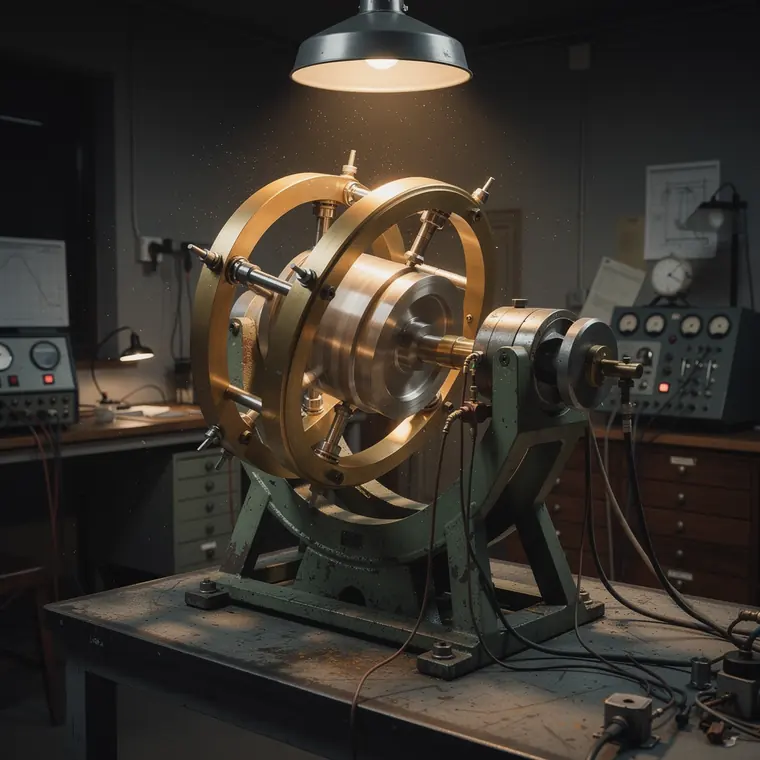
A set of nested gimbal rings holding a spinning mass at their centre, the innermost stage staying level while the outer rings are tilted right over, bright machined rings in three sizes one inside the other with bearings at their pivots, the rotor a polished cylinder blurring with speed, slip rings and fine wires at the pivots, the assembly on a test stand, in an instrument laboratory around 1950, one lamp lit above the platform so the rings gleam, the laboratory beyond dark.
- What it was used for
- The stabilised gyro platform is the core of an inertial navigation set. It is a table slung in gimbals which gyros, acting through servos, hold so that it keeps its direction in space while the vehicle rolls, pitches and yaws around it. Accelerometers sit on the table, and from their readings an analogue computer continuously derives position and course, with no view outside and no radio bearing. In Charles Stark Draper's Instrumentation Laboratory at MIT this design was called SPIRE and consisted of three single-axis gyros floated in fluid and three pendulous integrating gyro accelerometers. A temperature control held the viscosity of the bearing fluid near its set value, because only then did the effect of shear remain calculable. On 7 February 1953 SPIRE navigated a B-29 from Bedford, Massachusetts, to Los Angeles, on autopilot throughout. The equipment weighed 3,000 pounds.
- What was new
- What was new was independence from everything outside. Radio bearings need transmitters and celestial navigation needs stars and clear sky; the platform needed neither and delivered a position under cloud and in radio shadow. This became possible through the single-axis, fluid-floated gyro developed in Draper's laboratory in 1947, which Draper itself describes as the basis of the stabilised platform. The price is in the figure: the system was designed to hold navigation error below one nautical mile after ten hours of flight, and it weighed 3,000 pounds because, according to Philip D. Hattis, the design work had been aimed entirely at function and not at reducing size.
What the sources leave open: The sources consulted record no event for the year 1950. Hattis dates the predecessor FEBE flights to 1949 and the SPIRE flight to 7 February 1953, as does Draper's history page; only the latter dates the floated gyro to 1947. No priority follows, as both describe only this laboratory. Neither source states the cost of the system.