The Trainee's Log
1941 · Training Record · Work 670 of 1,871
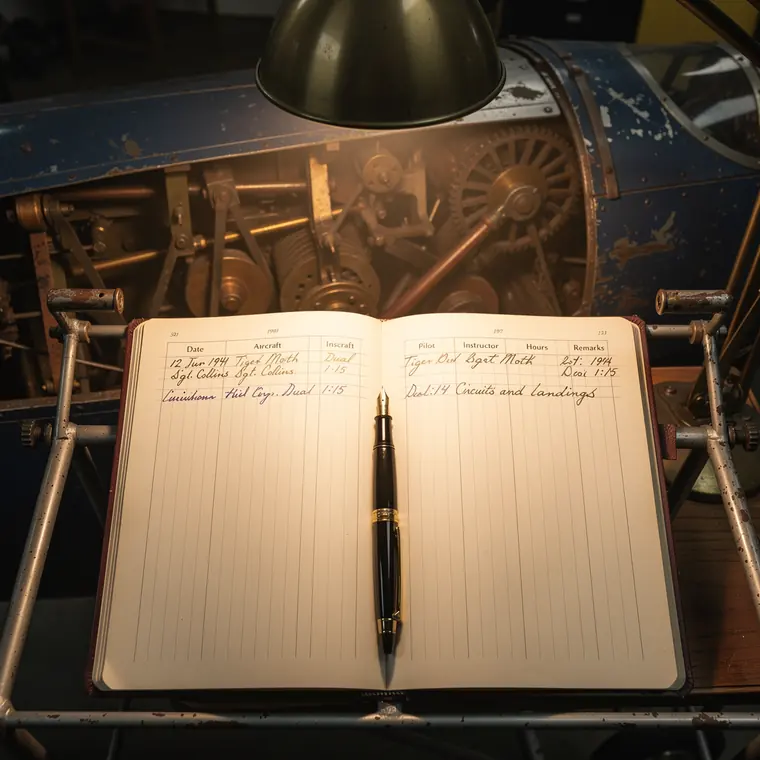
An open logbook lying beside a trainer, its pages ruled into columns, several lines entered in different hands and different inks, the writing seen at a shallow raking angle so it reads as a texture of pen strokes, then a run of blank ruled lines to the bottom of the page, a fountain pen lying in the gutter of the book, the blue side of the trainer in the background, in a flying school room, one desk lamp lit over the logbook, the room beyond dark.
- What it was used for
- The trainee's log book was the book in which every training hour was entered, including the hours spent in the Link Trainer. It is the source from which the amount of training done inside the closed box can still be read today: in the Air and Space Power Review, Trevor Nash draws on such log books and arrives at over 60 to 70 hours of Link time for one pilot after a tour of operations and over 90 hours for a pilot who then became an instructor. The RAF expanded its training sharply within a few years. In 1933 it put some 300 pilots a year through training; by the end of 1941 the figure was 22,000 pilots and 18,000 other full-time aircrew. The Air Ministry ordered 51 Link trainers, which entered service in September 1937, and a further 150 later.
- What was new
- A device meant to make training cheaper itself became too expensive. On 21 October 1941 the British Air Commission requisitioned on the RAF's behalf 100 Celestial Navigation Trainers, Link's large crew trainer. The number was later cut to 60 because the US forces had themselves requisitioned 121 units and output could not keep up. The RAF had hesitated beforehand mainly because of the price of 80,000 pounds per unit, by Nash's conversion about 5.17 million pounds in 2023 prices, which was held to be prohibitive. Delivery of the first unit was planned for June 1942 and slipped.
What the sources leave open: All figures come from a single paper: Trevor Nash, The RAF's Leading Role in the Development and Application of Synthetic Training Equipment, Air and Space Power Review 26/1 (2024), pp. 54-74. Nash states no rule by which trainer hours were credited against flying hours, and describes no form or assessment sheet. Whether the work means a log book or an instructor's sheet could not be settled; the log book is what is described here. Nash cites log books only as evidence for hours.