The Patch Panel
1952 · Analogue Programming · Work 672 of 1,871
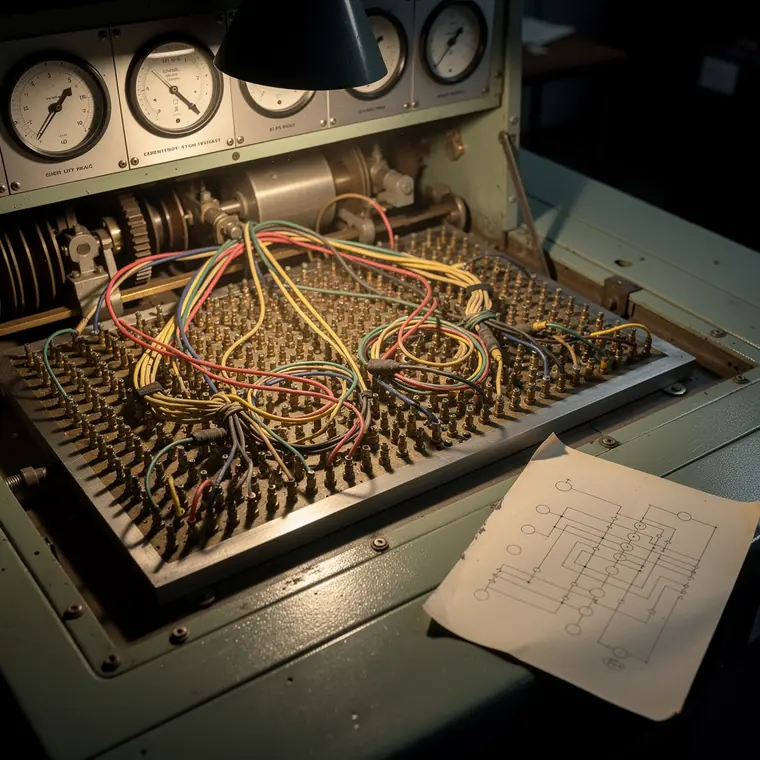
A removable patch board of hundreds of sockets in a grid crossed by a dense tangle of patch cords, cords in several colours plugged in loops and crossing bundles, the board in a metal frame on the front of an analogue computer console, a pencilled wiring diagram of lines and circles on a sheet taped beside it, meters with graduated dials and fine tick marks above the board, in a computing laboratory of the early 1950s, one lamp lit over the board so the cords cast crossing shadows, the laboratory beyond dark.
- What it was used for
- The patch panel was the front of an electronic analogue computer: a board of holes into which the operator plugged short cables to set which amplifier acted on which. The wiring was the program. An integrator feeding its output back to its own input through a potentiometer was a differential equation, and changing the equation meant moving cables. On the EAI 231R-V this panel was removable and had 3,450 holes; EAI describes it as a 3,450-hole removable pre-patch panel and patch-bay, justified on the ground that a program can be patched without interrupting work in progress. The wired board could be checked and stored away from the machine.
- What was new
- What was new was not the plugging but the lifting out. Early machines had jack fields that belonged permanently to the machine, and as long as a problem was patched the machine was tied up. The removable panel separated the program from the computer. That is where the barb lies, and Arthur I. Rubin of Electronic Associates supplies the figures: a single solution ran in 5 milliseconds, while changing over to another problem took several days at least, for want of a patch panel. Who had the removable panel first is not settled in Rubin's account. His text names Berkeley and Goodyear as the first machines with patch panels, in illustrations dating from about 1952 or 1953, while his own table lists a removable patchboard for the Reeves C100 of 1951.
What the sources leave open: Rubin's paper contradicts itself on this point, text against table, and the table is poorly legible in the PDF retrieved. No decision on priority is therefore offered here. The figure of 3,450 applies to the EAI 231R-V of 1964 and not to 1952.