The Function Generator
1950 · Curve Setting · Work 673 of 1,871
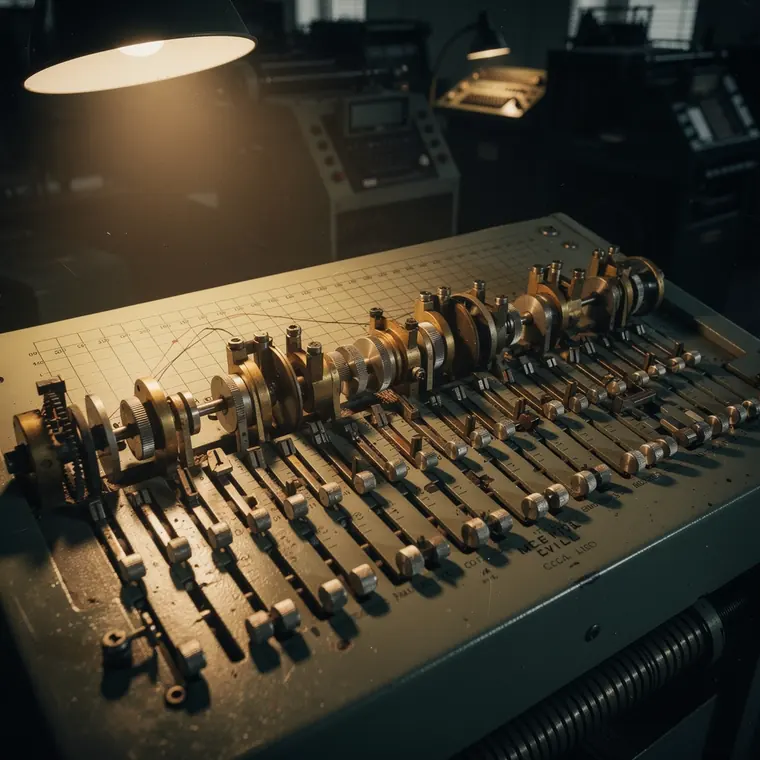
A row of small sliders set by hand to trace out an arbitrary curve, the slider knobs standing at different heights against a fine ruled grid behind them, the tops of the sliders forming the shape of the function as a rising and falling profile, a dense row of slots each with its knob, the panel plain grey, on the front of an analogue computer console, every object of 1950 make, in a computing laboratory, one lamp lit over the panel raking across the slider knobs, the laboratory beyond dark.
- What it was used for
- The function generator gave an analogue computer a curve for which there was no formula. Measured values were reproduced as a chain of straight segments. At each breakpoint a biased diode switched in and changed the slope; on the TR-48 the breakpoints were fixed and the operator set the slopes with a screwdriver. EAI supplied variable diode function generators with 10 or 19 segments for the TR-48 and describes them as units that produce an electrical representation of arbitrary functions by straight line segments. Fixed generators for the logarithm and for the square were sold alongside them. Without such units the analogue computer was limited to problems that could be written as an equation.
- What was new
- What was new was that a set of measurements became a component in its own right. An early survey of the basic operations shows no generator for arbitrary functions; Rubin supposes that it was developed later or was regarded as an oddity. A quantity could thus enter the computation that nobody could write down as a function but had only measured. The price was handwork and repeatability: every new curve meant resetting breakpoints and slopes, and Rubin gives precisely the elimination of drift and of poor reproducibility as the reason why the digitally controlled function generator replaced the diode type from 1968.
What the sources leave open: The sources consulted name no device and no event for the year 1950. Rubin lists tube diode function generators for 1956, the first description of the card-programmed diode function generator in 1958 and the fixed generators for sine, cosine and exponential for 1960-1965; the EAI figures of 10 or 19 segments belong to the TR-48 of the 1960s. Who first built the diode function generator is not stated in the sources.