The Hybrid Machine
1958 · Analogue-Digital Hybrid · Work 675 of 1,871
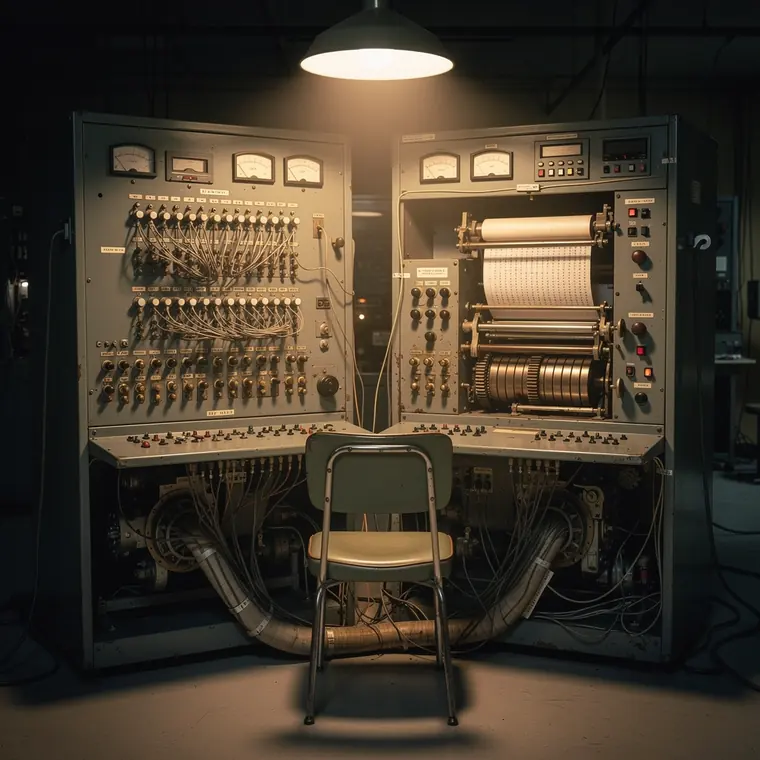
Two consoles standing side by side and cabled together, one with patch cords and meters with graduated dials and fine tick marks, the other with a card reader and printer, a thick cable trunk running between them along the floor, a single shared operator's chair between them, both consoles plain grey steel, in a computing laboratory of the late 1950s, one bank of lamps lit above the two consoles, the laboratory beyond dark.
- What it was used for
- A hybrid machine was an analogue computer and a digital computer wired together. The analogue side carried the running process forward in real time, the motion of a missile for example, while the digital side took on what needed accuracy and memory, that is tables, logic and record-keeping. They were joined by analogue-to-digital converters with a multiplexer and several digital-to-analogue converters. Along a second path EAI developed patchable logic of gates, flip-flops and registers, which was later built into the analogue computer itself. Packard Bell coupled the PB250 digital computer through its own converters to a desktop analogue computer, such as the T-50 from Computer Products or EAI's TR-48, and advertised the result, the HYCOMP 250, as the first desk top hybrid analog/digital computing system. Large analogue computers of the late 1960s had two patch panels, one for the analogue components and one for the digital logic.
- What was new
- What was new was that the two kinds of machine no longer competed but ran together. Priority cannot be cleanly assigned. Rubin traces the idea to George A. Philbrick, who in 1952 described a form of hybrid computation, namely a coarse solution on the analogue machine followed by a more accurate one on the digital machine, and he names the first conference on combined analogue-digital systems in December 1960 as the key date. The claim that the HYCOMP 250 was the first hybrid desktop computer is an advertising statement by Packard Bell. The barb lies in Rubin's own arithmetic: for reducing the data after a hybrid run he estimated two to five hours of digital computing time per hour of production run.
What the sources leave open: The sources consulted name no hybrid machine for the year 1958. The Computer History Museum catalogue dates the HYCOMP brochure to 1961 while the same museum's listing page gives 1964; the brochure itself (PDF at the museum) names EAI's TR-10 and TR-48 as well as the T-50 from Computer Products as analogue computers that could be connected; by its account the PB250 and converters stood in a rack 73 inches high. Rubin's figures date from 1970.
Further reading
- Computer History Museum, Katalog: HYCOMP 250 - The first desk top hybrid analog/digital computing system (Packard Bell)
- Arthur I. Rubin: Analog/Hybrid - What it was, what it is, what it may be, Fall Joint Computer Conference 1970, S. 641-652 (PDF)
- Packard Bell Computer: HYCOMP 250, Broschüre SP-182 (PDF, Computer History Museum)