The Analogue Answer
1955 · Result Comparison · Work 676 of 1,871
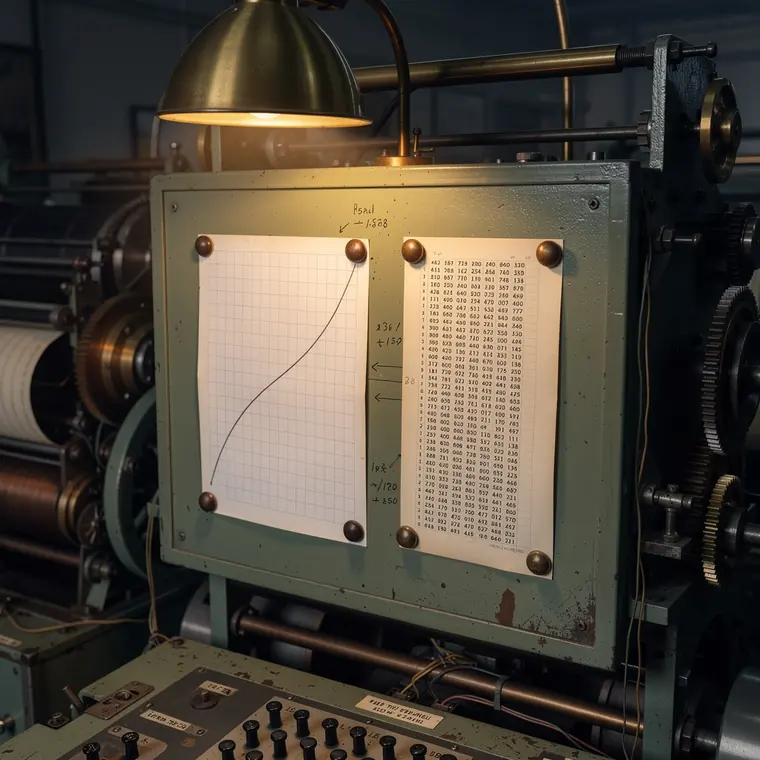
Two sheets pinned side by side on a board, one a sheet of ruled graph paper carrying a single continuous ink curve drawn by a machine, the other a printed column of computed figures seen at a shallow angle so the digits blur into texture, the same problem solved twice, small pencilled marks between them, a drawing pin at each corner, every object of 1955 make, in a computing laboratory, one lamp lit over the board, the room beyond dark.
- What it was used for
- What an analogue computer delivered was not a number but a voltage. It was made visible as a picture: on an XY plotter as a drawn curve, on a multi-channel recorder as a paper strip, and at high speed on an oscilloscope. Anyone needing a figure read it off the voltmeter, on the EAI TR-48 from a four-digit display with sign which EAI specifies as accurate to plus/minus 0.005 volt over the whole range. The engineer thus received not a column of numbers but the course of a motion, and saw from the shape of the curve whether a control loop settled or diverged. A single solution was available in 5 milliseconds according to Rubin, and the EAI 231R could run problems up to ten times faster than real time.
- What was new
- This field shows no innovation in the strict sense. What is documented is the difference from digital computation and its price. The answer appeared while the process ran, in the same time and in the same shape, and it was exactly as good as the components: Rubin gives an accuracy of about five per cent for early non-linear problems, while the later quarter-square multipliers approached 0.01 per cent. A curve with five per cent uncertainty shows a motion correctly and carries no figure one could quote.
What the sources leave open: This entry is thin. The sources consulted record no event and no device for the year 1955. The details of the output come from a manufacturer's publication for the EAI TR-48 of the 1960s, and the accuracy and timing figures from Rubin's 1970 retrospective.