The Storage Room
1960 · Retired Equipment · Work 677 of 1,871
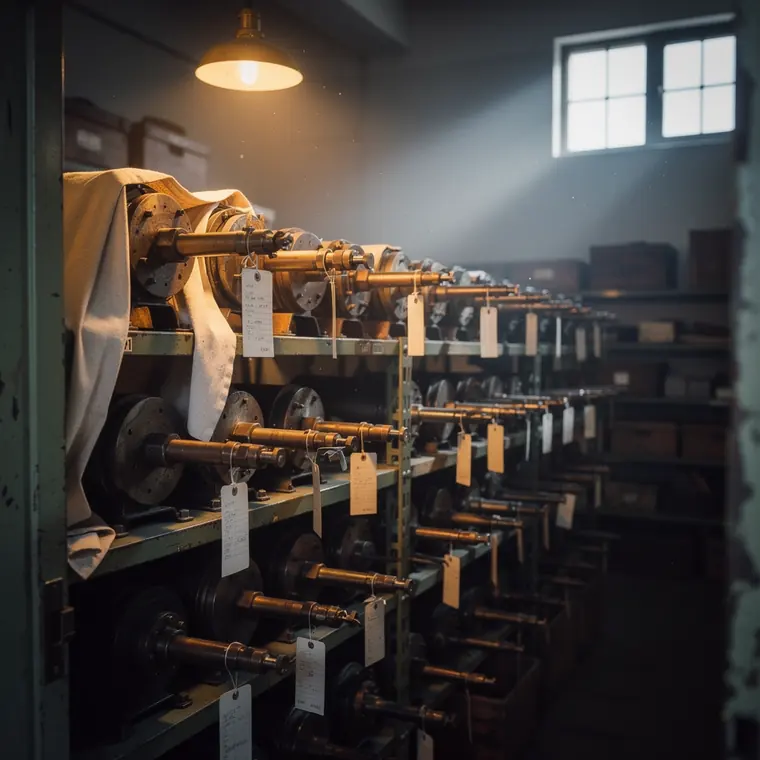
Integrator units stacked on steel shelving with their shafts protruding, each unit a disc with its small wheel resting on it and a shaft end sticking out into the aisle, dust sheets half over them, a plain paper inventory tag wired to each, dust on the discs, a window high on the wall, every object of 1960 make, in a storage room of a university, one bare bulb lit over the shelving, the far end of the room dark.
- What it was used for
- Because the program of an analogue computer was its wiring, it was not kept on paper or tape but as an object. The removable patch panel was lifted out of the machine with all its patch cords and put into storage. For the TR-48, EAI writes that patched boards can be stored for future use, and for the 231R-V the manufacturer's manual states that the panels' low-cost construction makes it practical to buy several spare panels for long-term program storage. A shelf of wired panels was thus the program archive of a computing laboratory. Each such panel on the 231R-V had 3,450 holes, and what was plugged into it was a model: an aircraft, a reactor, a control loop.
- What was new
- What was new was that a computing program became stock in a store, with shelf space and a write-in area for identification. That is not an invention with a date but a consequence of the patch panel being removable. The barb lies in two sentences from two sources. EAI sold spare panels expressly for long-term program storage, and Rubin writes that analogue installations were often tied up for a single project and frequently stood unused once it ended. A program lying on a shelf as an object needs the machine it fits; once that is dismantled, the shelf holds nothing but wire.
What the sources leave open: The sources consulted record no event for the year 1960, and they do not say who first stored patch panels. The two supporting statements about storage come from EAI manufacturer's publications for the TR-48 and the 231R-V, that is from a seller of spare panels. None of the sources describes a room expressly used as a store for patch panels; the last sentence of the neu field joins two separate statements and is not a quotation.