The Last Run
1962 · Final Operation · Work 678 of 1,871
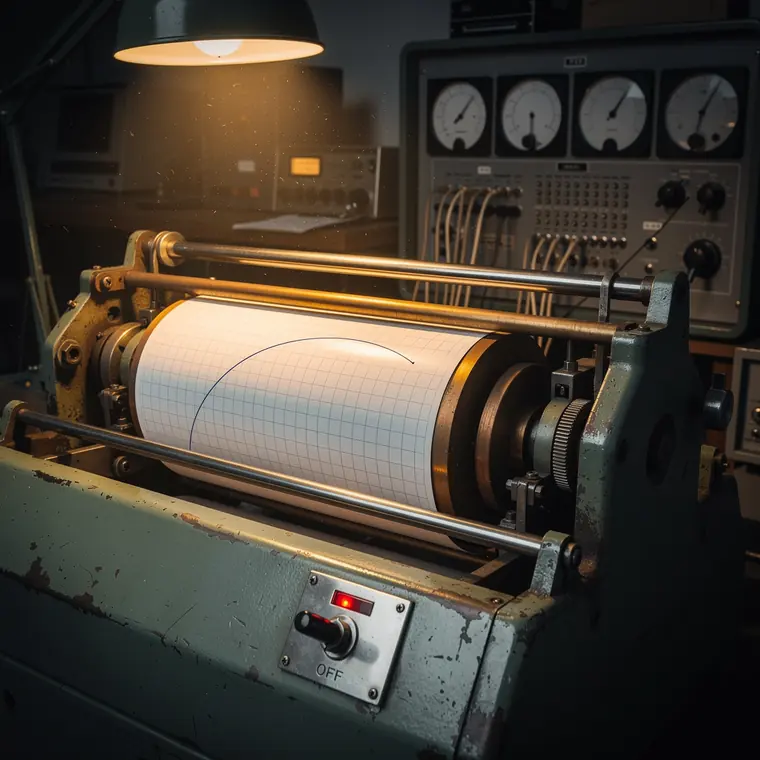
A plotting drum stopped mid-curve, the pen lifted and parked in its rest, the paper still on the drum a sheet of ruled graph paper carrying a single drawn curve that stops partway across, the large toggle power switch of the machine thrown down, its pilot lamp dark, the pen carriage on its rails, the analogue computer console behind with its meters at rest, in a computing laboratory, one lamp lit over the drum, the room beyond dark.
- What it was used for
- What is meant is the end of the analogue computer as a machine in its own right. Arthur I. Rubin, an employee of Electronic Associates, names firms and periods in his 1970 retrospective: Boeing, Goodyear and IDA, or by his own qualification perhaps Mid-Century, withdrew from this business roughly between 1955 and 1960, and between 1960 and 1965 Reeves more or less indicated that it was finished with analogue manufacture. The computing centres themselves did not disappear, they changed the type of machine. Small, recurring studies moved to digital machines of the IBM 7090 class, and the analogue consoles stood idle.
- What was new
- Nothing here is new, and the reason for the ending is the barb. Rubin writes explicitly that this shift was not a matter of speed, cost or accuracy but of the digital machine simply being there, in his words simply because it was available. The analogue computer was therefore not beaten on the merits but on availability. Rubin himself did not regard 1970 as the end: he reports that by then almost half of the larger consoles were being sold for hybrid installations. The analogue machine thus survived for a time by attaching itself to what was displacing it. That Rubin was writing for a manufacturer belongs with this statement.
What the sources leave open: The sources consulted record no event for the year 1962; Rubin gives periods, not years. Rubin was an employee of Electronic Associates, a maker of analogue and hybrid computers, and his paper is a 1970 retrospective rather than a disinterested judgement.