Home Insurance Building
1885 · Metal Frame Construction · Work 68 of 1,871
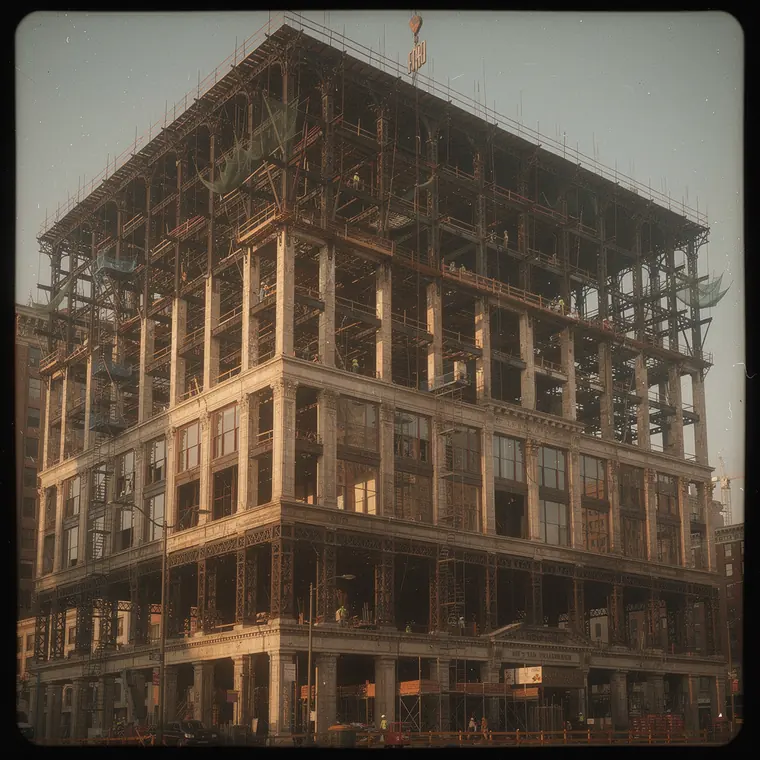
The Home Insurance Building in Chicago under construction, its metal skeleton of columns and beams standing bare, masonry piers being hung storey by storey around the frame.
- What it was used for
- Office building for the Home Insurance Company of New York at the corner of LaSalle and Adams, and its western headquarters. The brief was to fit as many small, well-lit offices as possible above the second storey. Jenney took out the building permit on 1 March 1884 deliberately early, because an ordinance limiting height to 100 feet was pending in the council. Chicago's ground is soft clay; the isolated footings were calculated for two tons per square foot, and a year after completion settlement across the whole building differed by a little under three-quarters of an inch. In 1893 the building held 235 offices, 1,250 occupants and four passenger elevators; the largest tenants were Armour & Co. and the Union National Bank. It was demolished in 1931, after 46 years, to make room for the Field Building.
- What was new
- One thing was new, and it can be stated exactly: in the upper eight storeys of the two street fronts, concrete-filled cast iron columns were built into the brick piers. That reduced the piers' cross-section and let more daylight into the small offices. It was not a skeleton frame in the modern sense: the two party walls carried through the full height, the first two storeys of the street fronts were load-bearing stone masonry, and there was no metal wind bracing - the masonry took the wind. Jenney first claimed the building as the first skyscraper in 1896 in the Engineering Record, eleven years after completion; Dankmar Adler and George B. Post contradicted him at once. Two panels examined it during demolition: the Tallmadge committee, appointed by the owner of the replacement building, awarded it the title in November 1931; the Western Society of Engineers concluded the opposite in February 1932.