To Bury the Past
1893 · The Revolutionaries · Work 680 of 1,871
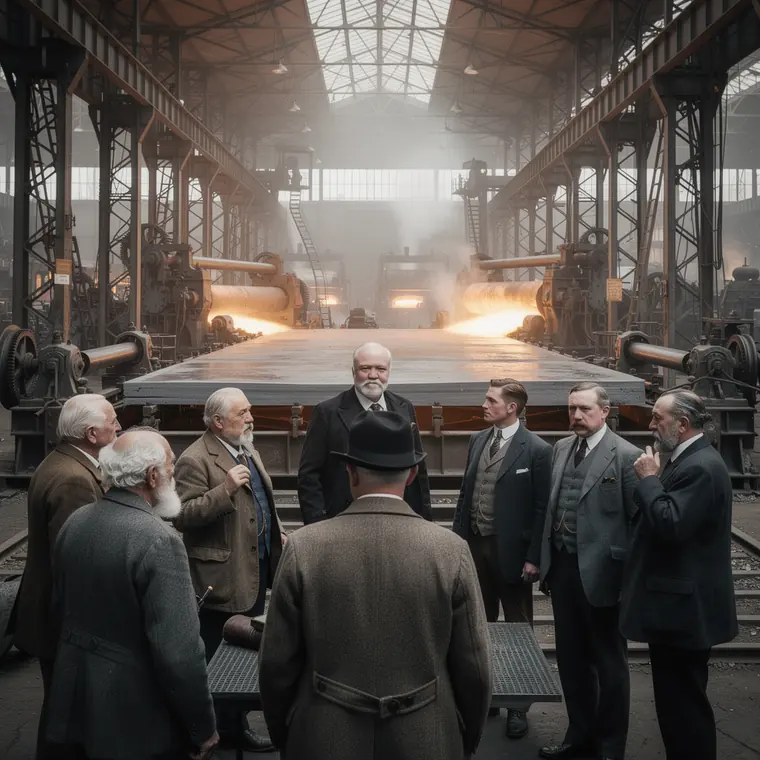
The rolling mill hall of a great steelworks, a winter day, 1 February 1893, a long high hall of iron columns and roof trusses, grey daylight through tall windows, an iron-plated earth floor, at the right a heavy plate mill stand with cast-iron housings, a glowing steel slab on its roller table, steam rising off the metal, open-hearth furnaces glowing at the back, in the foreground from behind elderly workmen in worn grey and brown wool jackets, nearest the camera a broad-shouldered roller in a leather apron, his hands half raised as he speaks, facing them across a few yards of floor six gentlemen in dark overcoats and bowler hats, in profile or with faces shaded by hat brims, and at the front of this group, in the centre of the frame, the man, a living figure in the scene and the only person whose face is sharp, a short stocky man of fifty-seven with a full grey-white beard and grey side-parted hair, bare-headed, bowler in hand, in a dark overcoat, his face turned toward the camera, the same distance from the camera as the men beside him, at his side a taller man, in profile, face shaded by his hat brim.
- Who
- Andrew Carnegie (1835–1919) was one of the richest industrialists of his age and one of its greatest benefactors. He was born in Dunfermline, Scotland, the son of a hand-loom weaver put out of work by the steam looms; in 1848 the family emigrated to Pittsburgh. There he started as a bobbin boy at $1.20 a week, became a telegraph messenger, a telegrapher and finally superintendent of a division of the Pennsylvania Railroad. With iron bridges and, from 1875, Bessemer steel he built a business that by 1900 produced more steel than all of Great Britain. His mills ran on long shifts and low wages, and in 1892 he backed his partner Henry Clay Frick, who set out to break the union at Homestead. In 1901 he sold his steel business to J. P. Morgan for $480 million and then gave his fortune away, among other things for more than 2,500 public libraries. His essay "The Gospel of Wealth" of 1889 is regarded as a founding text of philanthropy.
- The moment
- On 6 July 1892 at Homestead on the Monongahela, America's largest open-hearth steel mill, the locked-out workers fought 300 Pinkerton guards; seven workers and three Pinkertons died. From 12 July the National Guard occupied the town, and on 21 November the men went back on the company's terms, without a union. Carnegie was in Europe. On 30 January 1893 he declared in Pittsburgh that he had come not to rake up the past but to bury it. On 1 February he toured the works at Homestead and Braddock with Frick and other officials. By his own account he met old workmen who had taken no part in the riot and told them the company's offer had been generous. A roller replied that it had not been a question of dollars: the men would have let Carnegie kick them, but they would not let that other man stroke their hair. Carnegie gives no name; Frick is the obvious candidate. The picture shows this exchange in the rolling mill.
- The other side
- "The past, of which I knew nothing" was how Carnegie described what he wished to bury. His letters say otherwise. After the battle he cabled Frick: "All anxiety gone since you stand firm. Never employ one of these rioters. Let grass grow over works." Of the tour the company said that Mr. Carnegie always visited the mills when in Pittsburg and the trip had no other significance. The same report noted that a reduced wage scale had just been announced at Braddock. And the fight of 1892 was about pay on new machinery. As one of Carnegie's partners put it: "The Amalgamated placed a tax on improvements, therefore the Amalgamated had to go."
What the sources leave open: The exchange with the roller is recorded only in Carnegie's autobiography, written some twenty years later, which misdates the visit to 1892. The trade press gives 1 February 1893; a newspaper report of 27 January was not read, so there may have been two visits. In which hall the exchange took place is unknown; the hall in the picture is a typification, and Frick has no recognisable face.
Further reading
Sources
- PBS American Experience: Biography: Andrew Carnegie
- Carnegie Corporation of New York / Andrew Carnegie Foundation: Our History (Gospel of Wealth 1889, Gründung 1911)
- The Engineering and Mining Journal, Bd. 55 Nr. 5, 4. Februar 1893, Rubrik Pittsburgh
- Andrew Carnegie: Autobiography of Andrew Carnegie (1920), Kap. XVII (Projekt Gutenberg Nr. 17976)
- James Howard Bridge: The Inside History of the Carnegie Steel Company (1903), S. 251–252
- Jonathan Rees: Homestead in Context, Pennsylvania History 64/4 (1997), S. 525–526 und 529
- Rivers of Steel: Battle of Homestead Site, National Historic Landmark Nomination (300 Pinkertons, Tote, Nationalgarde, 21. November)
- Carnegie-Frick-Korrespondenz, Auszüge (Datum des Kabels 7. Juli 1892; nur Zweitbeleg)