London's Dreadful Visitation
1665 · Collected Plague Bills · Work 682 of 1,871
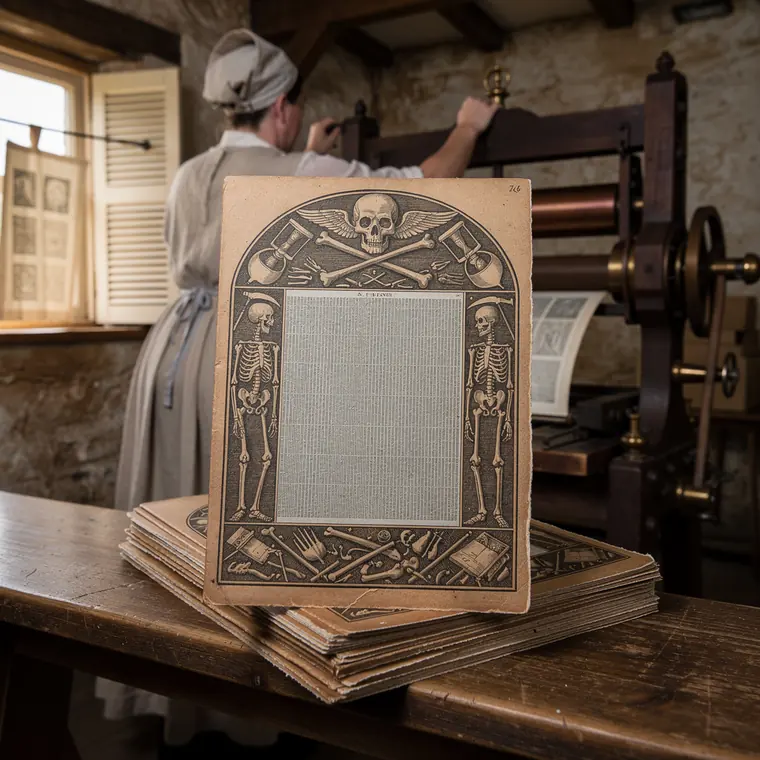
A stack of freshly folded thin quarto pamphlets on the bench of a small London press room in the autumn of 1665, the top pamphlet lying at a flat angle to the lens, its front page covered by a broad woodcut border of solid black ink with an arched top, the figures of the border left in the brown of the paper, a large human skull above two crossed thigh bones at the head of the border, a winged hourglass above the skull, one standing human skeleton in each side strip, grave-diggers' shovels and pickaxes and long bones in the foot strip, the panel inside the black border a field of soft grey lines, brownish handmade paper with deckle edges, behind the bench a wooden hand press with its long bar, damp sheets hanging over cords against the light, a woman printer seen from behind in a linen cap and apron with her hands on the bar, a window with its shutters half closed.
- What it was used for
- The book is the collected mortality record of London's 1665 plague, printed in the same year. Its basis was the weekly Bills of Mortality: the Company of Parish Clerks counted burials parish by parish, week by week, sorted by cause of death. Cause was first determined by the parish clerk, later by trained parish women, the searchers of the dead, who viewed the bodies. The regular recipients were above all the city's aldermen; the Crown and the Chancellor received copies, and from around 1600 the bills were also printed for the public. The general bill for the year ending 19 December 1665 lists 97,306 burials, 68,596 of them from plague. The worst week was 12 to 19 September 1665, with 7,165 plague deaths.
- What was new
- Unlike earlier commemorative and composite sheets, the volume carried no medical advice, prayers or advertisements, only reprints of the official weekly bills for a whole epidemic year; the printer justified it by how hard it had been in 1665 to find figures on the plague of 1625. Other European cities kept plague rolls that named the dead and gave their social standing; London counted only heads. That is exactly what made the bills analysable — John Graunt had shown a few years earlier what such series yield — and at the same time made every individual untraceable. The barb sits in the number itself: what was counted were burials in Anglican churchyards, not deaths. Catholics, Jews, Quakers and other nonconformists are missing. The 68,596 is therefore a floor, and the fullest document of the disaster is one that never recorded some of its victims.
What the sources leave open: The National Library of Medicine stresses that there is no evidence John Graunt produced the volume, though it was often later attributed to him; it was printed and sold by E. Cotes, printer to the Company of Parish Clerks. The original was not consulted.