The First Census of the United States
1790 · Handwritten Enumeration Books · Work 685 of 1,871
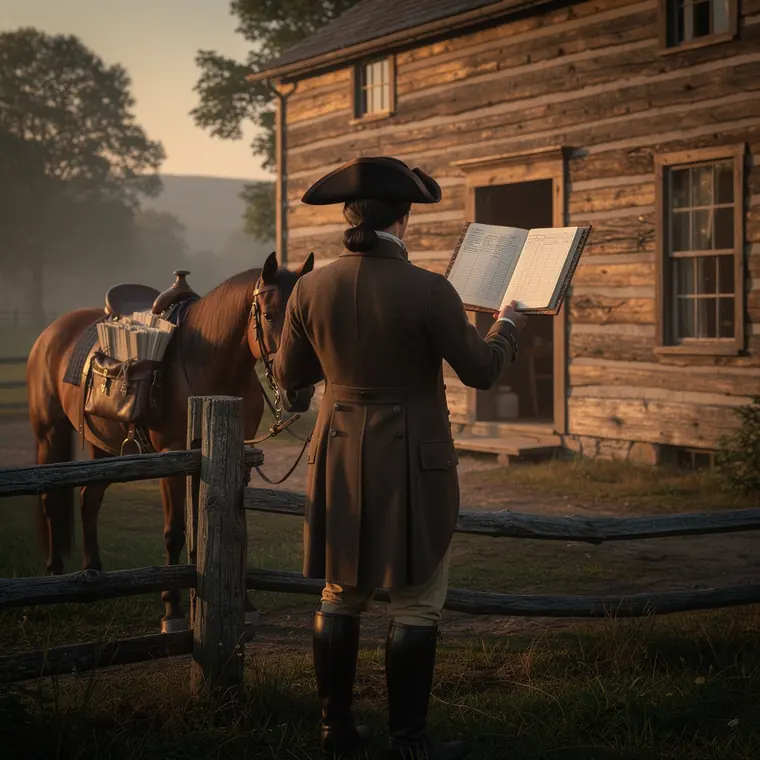
A travelling enumerator on his counting round of 1790 standing in the yard of a farm in Pennsylvania in late summer, seen from behind, dismounted, in a brown wool coat, riding boots and a black felt cocked hat, holding open in his left hand a narrow merchant's account book in marbled paper boards, its pages soft in focus showing only hand-drawn column lines, a bay horse tied to a split-rail fence post beside him, on the saddle a leather saddlebag holding bundles of paper sheets of unequal sizes tied with twine, behind them a squared-log house and an open plank door onto a dark interior, low golden evening light from the right.
- What it was used for
- The first census of the United States had a constitutional purpose: to apportion seats in the House of Representatives among the states. It was taken not by statisticians but by the federal law officers: 16 U.S. marshals, plus the governor of the Southwest Territory, William Blount, who had militia captains count his territory. The marshals used assistants — Clement Biddle deputised 32, Edward Carrington had 68 — and payment was by head: one dollar for every 50 to 300 persons enumerated, while the marshals themselves received between 100 and 500 dollars. It began on 2 August 1790 and officially ended on 2 May 1791, with extensions for Rhode Island, Vermont, South Carolina and the Southwest Territory. The result: 3,929,214 people. Jefferson laid the first tables before Congress on 24 October 1791 and issued the final report in 1793.
- What was new
- What was new was not the counting but the linkage: the Constitution required the same count to be taken afresh every ten years, and made the states' seats and tax burden depend on it. The number was therefore not merely information but a political act in itself. What that meant showed at once. The apportionment bill of March 1792 would have raised the House from 65 to 120 seats. Jefferson and Attorney General Edmund Randolph declared it unconstitutional on 4 April 1792, because it used two different divisors and gave eight states more than one representative per 30,000 inhabitants. Washington vetoed it on 5 April 1792 — the first veto by any American president. The override failed; the replacement act of 14 April set the House at 105 seats, fifteen fewer than planned.