Rickman's Abstracts
1801 · Parliamentary Population Abstracts · Work 686 of 1,871
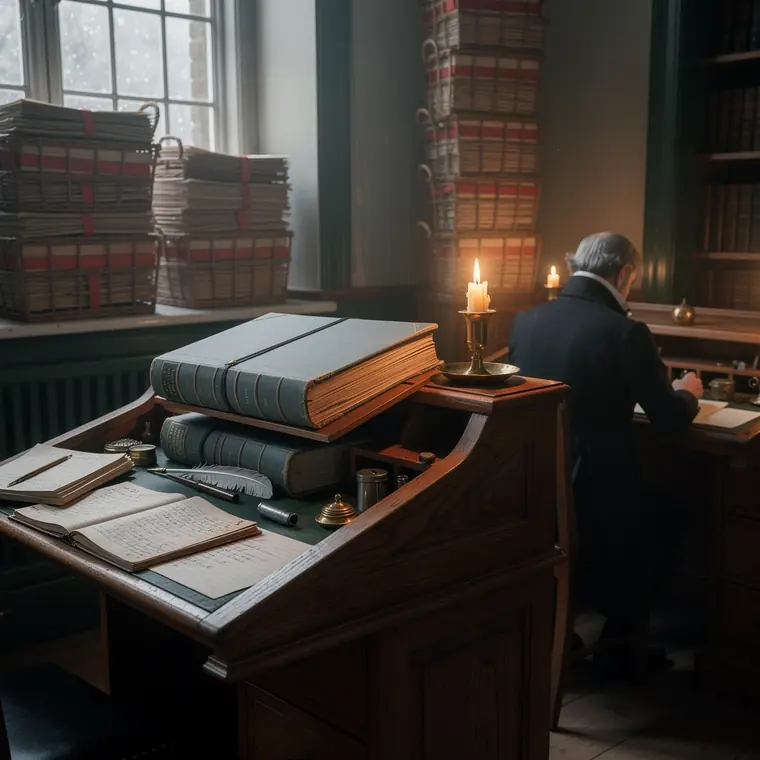
Two thick official volumes of 1801 lying closed one upon the other on a tall oak standing desk in a clerk's writing room of the old parliament building in London in winter, both volumes of equal size, each about six centimetres thick, bound in plain blue-grey paper wrappers with rough untrimmed edges, beside the desk wicker baskets stacked up to the window sill, filled with bundles of handwritten returns tied with red cloth tape, seen edge-on, a brass candlestick with a burning candle, a second clerk seen from behind at a neighbouring desk in a dark tailcoat, dark oak panelling, grey daylight through a leaded window meeting the warm candlelight.
- What it was used for
- John Rickman was an assistant clerk of the British House of Commons and prepared the abstracts of the first British census that were laid before Parliament. The count was taken on 10 March 1801 and the first abstracts were printed on 21 December 1801. In England and Wales the house-to-house enquiry fell to the overseers of the poor or other substantial householders, in Scotland to the local schoolmaster; the parish clergy answered the questions on baptisms, burials and marriages from the parish registers. The Act asked six questions: inhabited and uninhabited houses, persons by sex, those employed in agriculture, in trade and manufacture or otherwise, baptisms and burials in sample years from 1700 to 1800, marriages from 1754, and a field for remarks. Rickman ran the censuses from 1801 to 1831.
- What was new
- What was new was that the state had a figure instead of an estimate. For England and Wales it came to about 9 million; earlier estimates had ranged from 8 to 11 million, and it was disputed whether the population was growing or shrinking. A first census bill had been brought in by Thomas Potter in 1753 and had failed; Matthew Ridley, MP for Newcastle-upon-Tyne, objected at the time that he did not himself think counting people unlucky, but that many did, and that the opposition might turn riotous. In 1800 the bill passed easily. The barb sits in Rickman's own case for it: among his twelve arguments for a census stood, explicitly, planning for conscription and the food supply. And only numbers were collected, not names — the 1801 returns yield no dataset in which individual persons appear.