The Memorial on the Sixth Census
1844 · Statistical Protest Pamphlet · Work 688 of 1,871
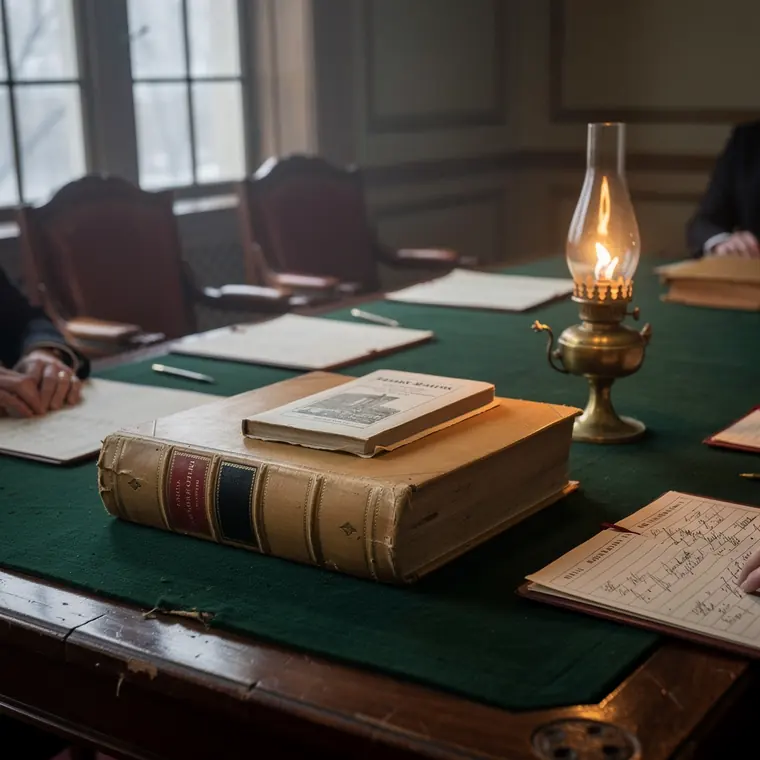
A thin stitched pamphlet of 1844 lying closed on top of a massive folio volume on a table covered in green baize in a committee room of the legislature building in Washington in December, the pamphlet an octavo of only eighteen pages, in a plain pale paper wrapper, soft in focus, the folio beneath it many times larger and about eight centimetres thick, bound in pale tan sheepskin with one red and one black leather panel on the spine, the panels showing only dull gilt lines, a brass oil lamp burning beside them, mahogany armchairs pushed back from the table, tall sash windows, grey winter daylight from the left.
- What it was used for
- The memorial of the American Statistical Association asked Congress to adopt measures for correcting the errors in the returns of the sixth United States census. It was submitted to the Senate on 10 December 1844 and ordered printed on 11 December, as S. Doc. 28-5 of the 28th Congress, second session. Its occasion was a new category in the 1840 census: "insane and idiots". The physician and statistician Edward Jarvis had recomputed the returns. In Worcester, Massachusetts, he found all 133 white inmates of the mental hospital recorded as Black, and many localities listing more insane Black residents than Black residents in total. He suspected the numbers had been entered in the wrong columns.
- What was new
- What was new was who was checking whose arithmetic: a learned society audited its own government's figures and formally demanded their correction. That was necessary because the figures were already in political use. In 1843 the Southern Literary Messenger used them to argue that in the free states one Black person in 143 was insane, in New England one in 34, but in the South only one in 1,605 — freedom, ran the inference, harmed them. In April 1844 Secretary of State John C. Calhoun invoked the census in a letter to the British minister Richard Pakenham to argue that emancipation had worsened conditions for Black people. John Quincy Adams raised the errors repeatedly on the floor of the House. The barb: little was corrected. Calhoun had the former census superintendent William A. Weaver review the complaints; his report of January 1845 found eleven cases where Jarvis had misread the numbers and attributed most of the rest to wanderers and vagrants.
What the sources leave open: The memorial itself was not read in full text; title, number and dates come from the GovInfo catalogue entry. The insanity ratios are the Southern Literary Messenger's computation from the census data, not figures stated by the census. That little could be done to correct the figures is the Library of Virginia's statement.