The Dutch Bevolkingsregister
1850 · Continuous Population Register · Work 689 of 1,871
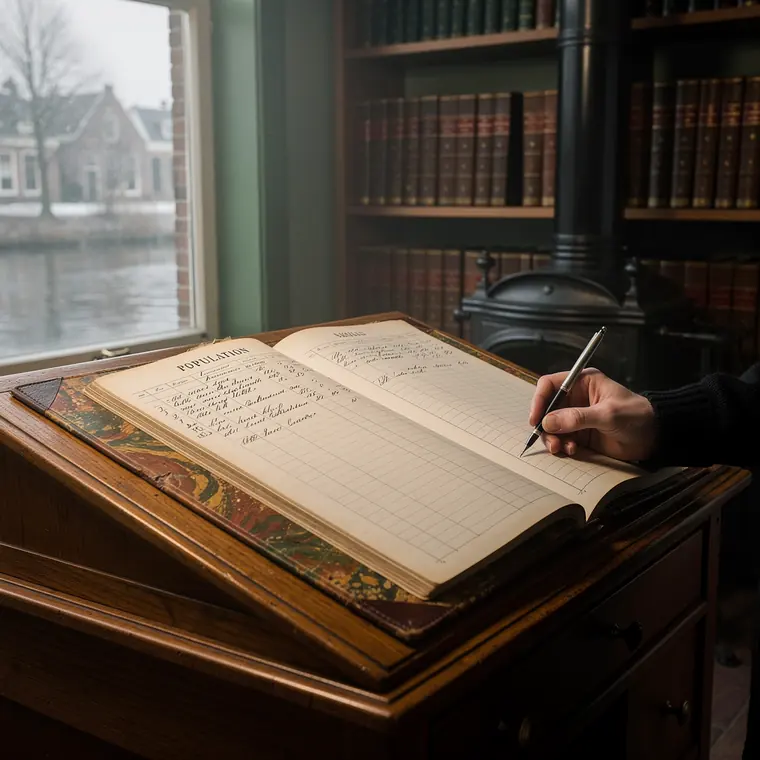
A large population register volume of 1850 lying open on a sloping oak desk in the office of a small town hall in the Netherlands in January, seen from the side at a flat angle, the open double page about fifty-three centimetres wide and forty high, cream paper crossed by a grid of fine ruled lines in twenty narrow columns, a few rows struck through in ink, the volume bound in half leather with marbled paper sides, a clerk's hand in a black wool sleeve holding a steel pen at the margin, behind it a shelf of volumes of the same height, a cast-iron stove, a tall window looking onto a canal, pale winter daylight from the left.
- What it was used for
- The bevolkingsregister was the continuously updated inhabitants' register of Dutch municipalities. It began officially in every municipality on 1 January 1850, built on the third national census of 19 November 1849. Unlike a census it was not a single date but a book that ran on: births, deaths, marriages, arrivals and departures were entered or the old information struck out, and every ten years a new volume began, copied from the previous one. For each person it held name, sex, date and place of birth, relation to the head of household, marital status, occupation, religion, address, date of arrival and previous residence. Around 1920 most municipalities moved from books to family cards filed by surname, and later to individual cards that travelled with the person to a new municipality.
- What was new
- What was new was that the state, nationwide, no longer merely counted its inhabitants but kept writing them forward; some places had kept such registers earlier, the province of Zuid-Holland from 1845, part of Gelderland from 1811. A register that carries moves with it answers questions a census cannot — who moved where, how long someone lived where — and it forgets nothing between two census dates. The barb is what this apparatus was available for 91 years later. On 3 February 1941 the authorities, on German orders, required all Jews to register. The municipalities carried this out within the existing bevolkingsregister: the entry went onto the person's own file, and so the card could be found faster, a tab marked J or B was clipped to it. By August 1941, 140,552 Jews and 160,820 people in total had been registered. The Anne Frank House writes that the registration made it possible to locate the people concerned and remove them from the country.
What the sources leave open: None of the sources consulted names a legal basis for 1850 — decree or act. On the move to the individual card the accounts diverge: FamilySearch gives 1940 with some cards for 1938 and 1939, dutchgenealogy.nl gives 1938.