The Seaton Tabulating Device
1872 · Roller Tallying Frame · Work 691 of 1,871
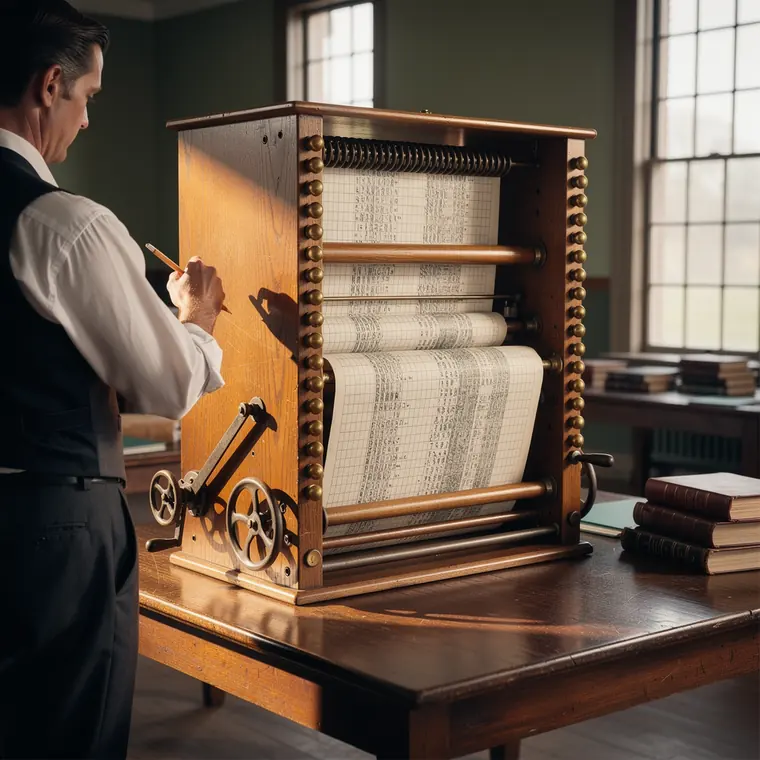
A wooden tallying device of 1872 standing on a long table in a hall of a government statistics office in Washington, an upright box of varnished grained wood about seventy centimetres on each side with a closed side wall and an open front, in the open front horizontal wooden rollers at several heights, a dense row at the top and more below, broad sheets of paper running over the rollers so that narrow strips of many sheets stand close together, the sheets a tight grid of ruled lines with bundles of pencil strokes, along the top edge of the side wall a row of small round brass knobs, low on the side wall two iron cranks with cross handles and a slanting rod between them, a clerk in shirtsleeves and waistcoat seen from behind with a pencil over the paper, daylight from tall windows.
- What it was used for
- Charles W. Seaton was chief clerk of the United States Census Office and in 1872 invented a device to ease the tallying of census schedules. Before it, clerks counted everything by hand: from 1850 the forms recorded individuals rather than households, and clerks kept ever more complicated tally sheets with running totals by enumeration district and characteristic. Seaton's device kept the lines of these large sheets isolated and organised; as Computing Before Computers describes it, this simple contrivance enabled several tally sheets, combined on one length of paper, to be brought conveniently close together. The Census Office bought it and used it to finish the 1870 census. Seaton later became superintendent of the 1880 census, where the device was used again.
- What was new
- Little here was new, and that is the point: the device did not calculate, it only ordered the paper. The Census Bureau itself calls it, in retrospect, a rudimentary tallying machine. The barb lies in the effect: despite the device, tabulating the 1880 census took almost the whole decade. That delay is precisely what led, in 1889, to the competition for a method for the 1890 census, won by Herman Hollerith's punched-card machine. The Bureau explicitly justifies the switch by the delays caused by hand counts and the rudimentary tallying machines of 1880.
What the sources leave open: Another Census Bureau page (Tabulation and Processing) has Seaton becoming chief clerk only in 1880 and gives 1887 as the end of the 1880 tabulation. No source names a patent. On how long the 1880 tabulation took, the sources give about seven years (Computing Before Computers) and almost a decade (Census Bureau). An older Bureau page under census.gov/history/www/ could not be retrieved without clearance.