The Broom Cupboard
1911 · Census Night Protest · Work 696 of 1,871
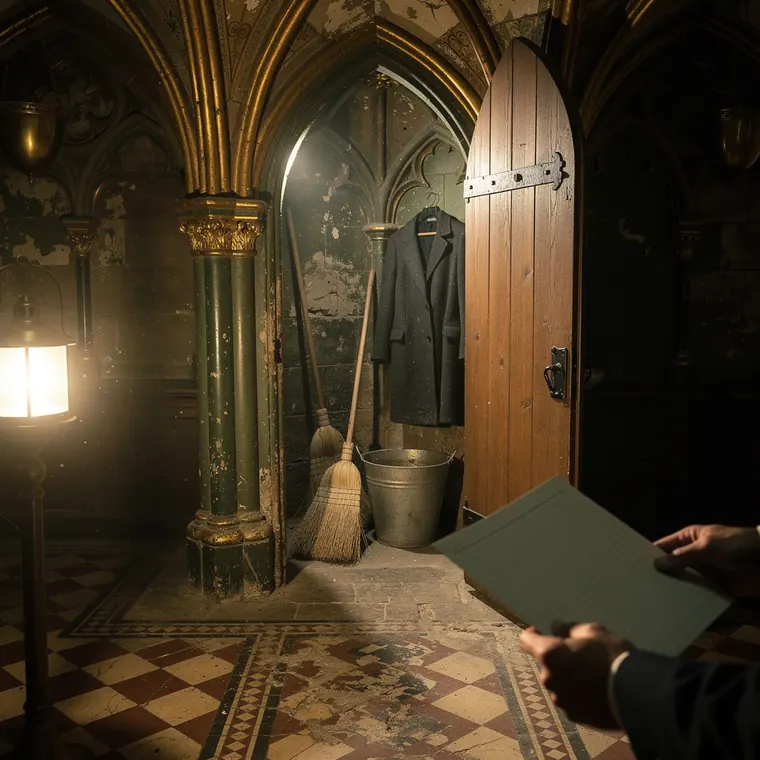
A narrow broom cupboard of 1911 at the back of a painted Victorian crypt chapel beneath a great medieval hall in London at night, a neo-Gothic wall cupboard with a single oak plank door on wrought-iron strap hinges, the door standing a hand's breadth open, inside on the stone floor a galvanised bucket, two brooms and a folded dark wool overcoat, low ribbed vaults above with gilded ribs, a floor of encaustic tiles in buff, red and black, the light of a hand lantern falling from the left, in the foreground the hand of an official in a dark serge sleeve holding a folded sheet of pale grey-green paper, its ruled grid blank, soft in focus.
- What it was used for
- The broom cupboard stands in the Palace of Westminster, and in it Emily Wilding Davison hid on the night of the British census, Sunday 2 April 1911. Davison was a suffragette, and the purpose was to be able to give the House of Commons as her address — the Parliament that refused women the vote. The 1911 census was the target of a boycott called by Emmeline Pankhurst: refusing to fill in the form risked a five-pound fine or a month's imprisonment. Some wrote slogans across their forms, such as "No vote - No census"; others stayed away overnight and gathered on Wimbledon Common, in Trafalgar Square, or in a house in Manchester known as Census Lodge. Davison stayed, on Historic UK's account, for 46 hours, was discovered by a cleaner, arrested, and released without charge.
- What was new
- The boycott used the enumeration form itself as a political instrument: not striking against an authority but refusing or redirecting the statement the state depends on. The barb is the result. Davison was counted twice: once with an entry recording that she had been found hiding in the crypt of Westminster Hall, and at the same time by her landlady in Coram Street. The boycott did the state little harm — many of the protesting women appear in the lists anyway, so its effect can be judged negligible — but the broom cupboard remained. Tony Benn fixed a plaque there around 1991 which reads: "In this broom cupboard Emily Wilding Davison hid herself, illegally, during the night of the 1911 census."
What the sources leave open: The 46 hours and the double entry appear only in Historic UK; the UK Parliament page states neither. The Parliament page dates the plaque to about 1991 and gives the quoted sentence verbatim. None of the sources consulted gives a total for the number of women who evaded the census.