The Census Bureau's Own Tabulator
1920 · Printing Tabulating Machine · Work 697 of 1,871
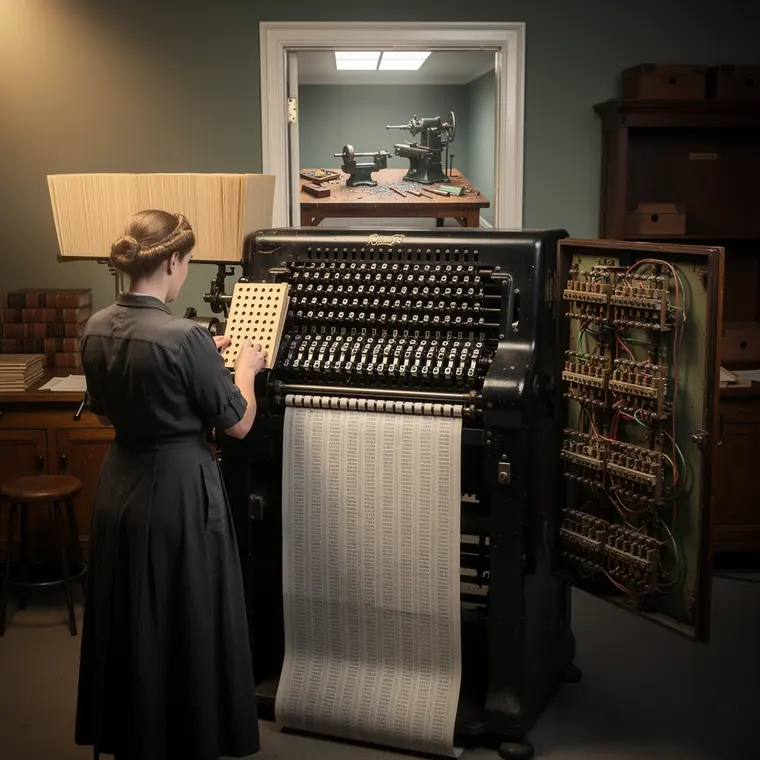
A tabulating machine built in a government workshop, standing in a machine room of a statistics bureau in Washington in 1920, a broad squat machine of black enamelled cast iron ninety-nine centimetres tall, one hundred and thirty-five wide and fifty-six deep, across its front a dense field of sixty small four-wheel counters with bright steel printing wheels, a narrow strip of paper hanging from the counter field with columns of figures as a grey texture, at the left a card feed holding a stack of sand-coloured cards with round holes, at the right an open panel of fifty small relays with cotton-covered wires, behind the machine through an open door a workbench with a lathe and a vice under a skylight, a woman operator seen from behind in a dark dress with rolled sleeves at the card feed.
- What it was used for
- This tabulating machine counted the punch cards of the United States census. What makes it unusual is who owned it: the Census Bureau had built it in its own workshop rather than renting machines designed by Herman Hollerith. It took 24-column cards. A reading head of wire brushes passed over each card, every brush dropped through its hole, closed a contact and advanced one of 60 four-digit counters, whose totals were carried to printing wheels. The Smithsonian dates the surviving example to 1920 and states that it was first used in the 1920 census and again, after modification, in 1930.
- What was new
- The principle had been in use since the 1890 count. What was new was ownership. The Census Bureau itself records that after Hollerith raised his rental prices sharply it decided to develop replacements in-house. The Smithsonian writes that Director Simon N. D. North set up a workshop staffed by engineers and mechanics for the purpose. The agency turned from tenant into maker of its own tool. The cost showed quickly: James Legrand Powers, who led the development inside the Bureau, left in 1911 with the patent on his machine and founded his own firm. The Bureau had freed itself from one supplier and produced another. According to the Smithsonian the Powers Accounting Machine Company went bankrupt in 1920 and passed to Remington Rand in 1927.
What the sources leave open: No source gives an exact year for setting up the in-house workshop: the Census Bureau places the decision after the 1900 count, with the newly formed Bureau, the Smithsonian under Simon N. D. North, Director from 1903. Neither page gives a card throughput figure.