The 1890 Fragments
1921 · Burned Census Schedules · Work 698 of 1,871
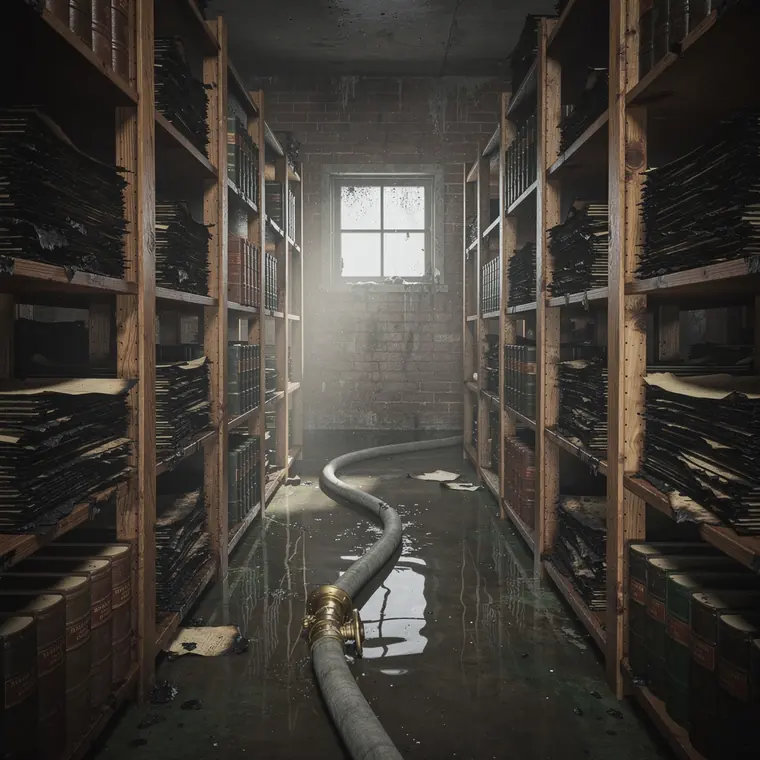
The basement file room of a government office building in Washington on a January morning of 1921 after a fire, narrow aisles between rough unpainted pine shelves standing close together from floor to ceiling, on every shelf orderly stacks of large paper sheets seen only from their edges, the edges charred black and brown, the stacks swollen and sagging from hose water, ankle-deep dark water covering the concrete floor and mirroring the shelves, a limp grey canvas fire hose with a brass coupling lying along the aisle, soot-streaked brick walls, a thin veil of smoke under the low ceiling, grey daylight falling from a small basement window at the far end, a deserted silent room.
- What it was used for
- These are the remains of the handwritten schedules of the 1890 United States census, the sheets on which every household was entered by name. On the evening of 10 January 1921 the basement room of the Commerce Building in Washington where they were stored caught fire. The fire brigade flooded the building for hours. The cause was never established. In December 1932 the Census Bureau's chief clerk sent the Librarian of Congress a list of records no longer needed, which included the damaged 1890 schedules. Congress authorised their destruction on 21 February 1933, and according to a National Archives record reproduced by IPUMS it was carried out in 1934. IPUMS states that some 6,000 records survive.
- What was new
- There is no technical novelty in these fragments. What is new is what they document: that fire alone was not enough to lose this record. It was destroyed in two steps, in 1921 by flames and firehose water and in 1933 by a signature, twelve years later. In between, the damaged papers remained in storage. Census Director William Steuart had warned that they would continue to deteriorate while funds for an archive building were awaited. President Herbert Hoover laid the cornerstone of the new National Archives Building one day before Congress authorised the destruction. How severe the fire damage actually was remains unsettled.
What the sources leave open: Accounts of the extent of the damage conflict. The Newspapers.com blog gives 25 per cent destroyed and about half the remainder badly water-damaged. IPUMS writes that the estimates did not agree, ranging from a quarter to total ruin. The Census Bureau gives no percentage at all. Newspapers.com places the outbreak in the evening of 10 January 1921, IPUMS in the afternoon.