The Ritter Files
1936 · Card Index and Calipers · Work 701 of 1,871
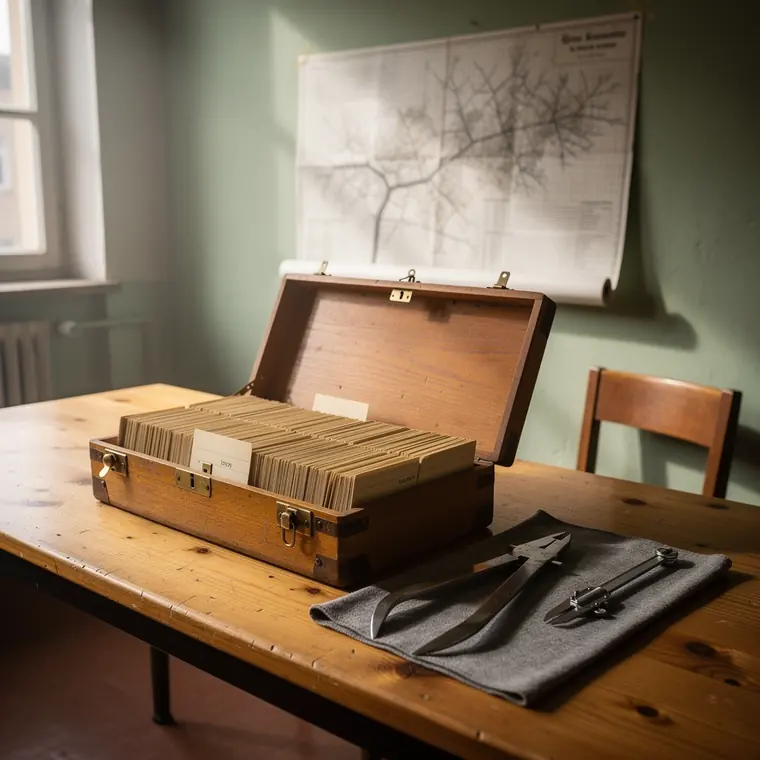
A workroom of a research office in Berlin in 1936, on a long plain pine table an oak card index box about forty centimetres long with its hinged lid open, filled with upright buff cards behind blank guide cards, seen from their top edges, beside the box a spreading caliper with two curved arms and a sliding caliper, both of nickel-plated steel on a grey cloth, in the background soft in focus a half unrolled paper chart on the wall with a branching web of fine lines, a wooden chair pushed back from the table, bare plastered walls painted pale green, brown linoleum floor, cold north light from a tall window on the left, a deserted silent room.
- What it was used for
- Robert Ritter was a physician and directed the Racial Hygiene and Population Biology Research Unit, set up in late 1936 at the Reich Health Office in Berlin. Its task was to register and classify Sinti and Roma. Its staff compiled family trees, compelled their subjects to give information about their family relationships, took measurements, made thousands of anthropological photographs and collected blood and hair samples. Himmler's decree of 8 December 1938 charged the unit with registering all Sinti and Roma in the Reich in close cooperation with the SS and the police. The NS-Dokumentationszentrum München writes that classification was thereby extended to everyone over six years of age. By the end of the war some 24,000 assessments had been produced.
- What was new
- What was new was not racial anthropology, which was already established before 1933, but its coupling with the police. An assessment from this unit was not a publication but a paper that decided a person's fate. The Documentation Centre of German Sinti and Roma writes that these assessments were instrumental in the deportations to concentration and extermination camps. Ritter shifted the supposed problem from the group to its mixing: according to the NS-Dokumentationszentrum München the unit sorted those registered into 34 groups and issued recommendations for forced sterilisation and forced abortion. Ritter himself went unmolested after 1945, worked from 1947 to 1950 as a doctor at the Frankfurt municipal health office, and the investigation initiated by survivors was dropped.
What the sources leave open: Both sources give around 24,000 assessments: the NS-Dokumentationszentrum "just under 24,000" by 1944, the Documentation Centre of German Sinti and Roma "some 24,000" by the end of the war. Neither states how many individuals were covered.