DEHOMAG D 11
1936 · Tabulating Machine · Work 702 of 1,871
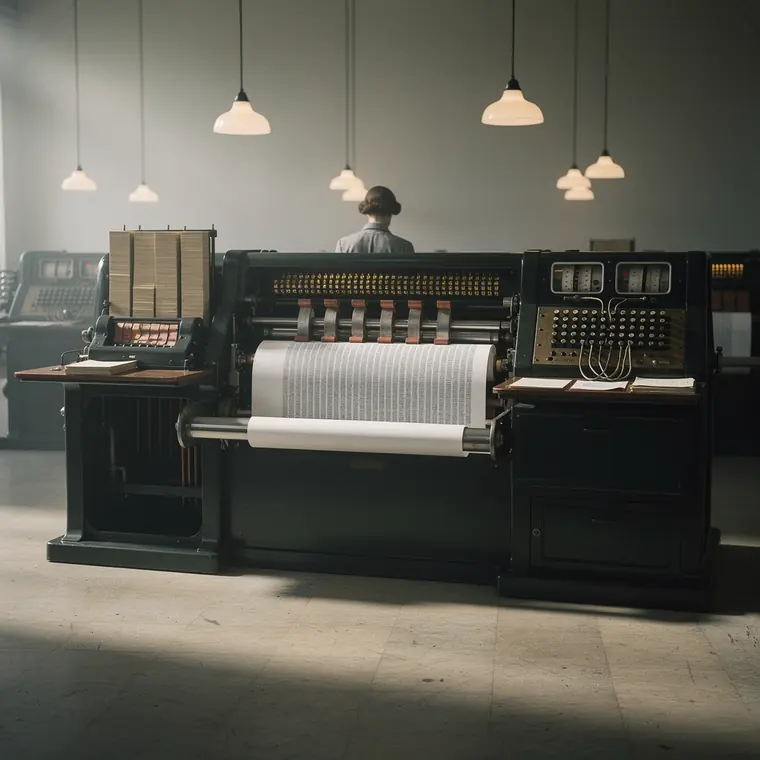
A large tabulating machine in a bare machine hall in Berlin in 1936, a long block of black enamelled sheet steel and cast iron on a plinth, two metres ten wide, eighty centimetres deep and one metre twenty-five tall, at its left end a card feed with a stack of sand-coloured cards, in the middle a printing unit with seven type bars and a wide paper roller carrying a sheet of close columns as a grey texture, at the right three small glass windows over counters and a plugboard of round sockets with short patch cords, bright steel parts along the card path, smooth plain panels on every side, bare walls painted pale grey, a seamless stone-composition floor, cold light from milk-glass pendant lamps, further identical machines soft in focus behind, a woman in a plain grey work coat seen from behind at the card feed.
- What it was used for
- The D 11 was a tabulator: a cabinet some 1.3 metres high and over two metres wide that read punch cards, counted, calculated and printed the result itself. It was built by the Deutsche Hollerith-Maschinen Gesellschaft, or Dehomag, in Berlin-Lichterfelde, an IBM subsidiary since 1924. For the German census of 17 May 1939 the Statistical Office of the Reich put tabulators of this type to work. According to the Heinz Nixdorf MuseumsForum some 750,000 enumerators were in the field, 80 million punch cards stood ready, and the machine park comprised 400 punches, 300 verifiers, 70 sorters, 50 tabulators and 25 card duplicators. Each day 450,000 cards were punched, later up to a million.
- What was new
- Tabulators had existed since 1890, and Dehomag had until then imported, manufactured and rented punch-card equipment. What was new, in the account of the Heinz Nixdorf MuseumsForum, is that the D 11 was the first machine of its kind developed in Germany. It was the heart of many Hollerith departments. The museum gives around 1,100 units sold. What it could not do matters just as much to its history: the punch cards carried no names, only the enumeration district and the position in the list. Names and addresses were on the supplementary cards, which after the tabulation lay at the Statistical Office of the Reich and were available to other authorities.
What the sources leave open: The build year is imprecise. museum-digital dates the type to 1935-1936 with production running to 1945. The USHMM dates its own example to 1930-1939 and states that machines of this type processed the 1933 and 1939 German censuses. The 1933 count predates the type's production start.