The Woolworth Wallet Card
1938 · Wallet Sample Card · Work 705 of 1,871
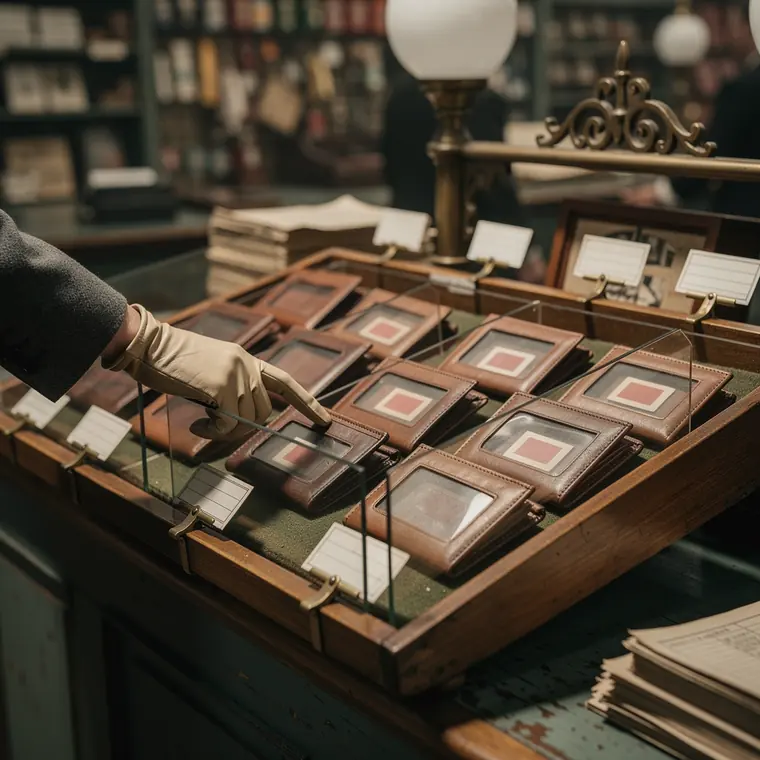
The sales counter of a five-and-dime department store in a small town in the United States in 1938, a flat wooden display tray divided by upright glass partitions, in it rows of brown leather wallets lying opened flat, each wallet with a clear celluloid window pocket, the sample cards tiny and soft in focus, a small red rectangle in each window, the sharp focus lying on the grain and stitching of the leather, small brass price-ticket holders holding blank white tickets, a customer's hand in a beige kid glove and a wool coat sleeve reaching for one wallet, bright store light from white glass globe lamps, the sales aisles soft in focus behind.
- What it was used for
- This was a specimen card that in 1938 lay inside wallets made by the E. H. Ferree Company of Lockport, New York. It was meant to show that the then new social security card fitted into the wallet. Douglas Patterson, the firm's vice president and treasurer, had his secretary's real number printed on it: Hilda Schrader Whitcher, 078-05-1120. The specimen was only half the size of a real card, printed entirely in red, with the word "specimen" across the face. The wallets were sold at Woolworth and other department stores across the country. According to the Social Security Administration more than 40,000 people later gave this number as their own, 5,755 of them in 1943 alone.
- What was new
- Nothing about the card itself was new. It was advertising material. What was new was what it exposed. The social security number had been introduced in 1936, and many buyers of the wallet adopted the specimen's number as their own, against the card's own printing: the word "specimen" ran across the face of the card and helped not at all. It was not the company that paid but the secretary. The agency voided the number, warned against its use and gave Mrs Whitcher a new one. That too helped only so far: as late as 1977 twelve people were found still using the old number.
What the sources leave open: The account comes from the Social Security Administration. Its page ssa.gov/history/ssn/misused.html blocks scripted requests but loads in a browser and carries every detail, including the company name and Patterson's position. The reproduction in Eastman's Online Genealogy Newsletter is no longer reachable. Gizmodo retells the story in shortened form.