The Persoonsbewijs
1941 · Fingerprint Identity Card · Work 708 of 1,871
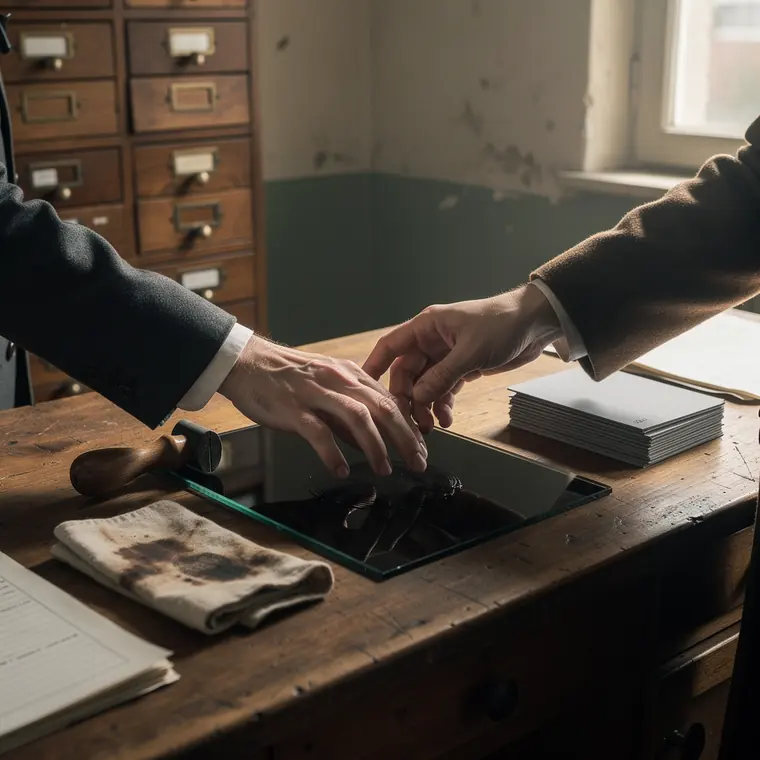
The counter of a municipal office in the Netherlands in 1941, on the worn wooden counter top a sheet of plate glass about twenty by thirty centimetres rolled with a thin even film of black ink, a small rubber roller with a wooden handle, a folded cotton rag, beside them a stack of closed folded identity cards of stiff plain unmarked grey-white card lying back cover up, a clerk's hand in a dark grey civilian jacket sleeve guiding the index finger of a second hand in a brown wool coat sleeve toward the inked glass, wooden card index cabinets soft in focus behind, bare plastered walls painted pale cream, pale daylight from a window on the right.
- What it was used for
- The persoonsbewijs was the identity document that everyone in the occupied Netherlands had to carry at all times from the age of fifteen. It was designed by the Dutch civil servant Jacobus Lambertus Lentz together with the German occupiers and introduced in the spring of 1941. It carried a photograph and a fingerprint, and the particulars were recorded in a central register. The Verzetsmuseum writes that no country in Europe had an identity document as technically and administratively perfect. With it the occupiers checked people for forced labour in Germany, for the persecution of Jews and for tracking down members of the resistance. From mid-1941 a large "J" was stamped into the documents of Jews.
- What was new
- What was new was not the document but its countercheck. For every persoonsbewijs there was a second piece of paper: a receipt bearing the fingerprint and photograph, kept centrally. A card presented could therefore be checked against the file, and a good forgery alone no longer sufficed. That is precisely why the resistance had to reach not only for the paper but for the file. This is what the attacks on the registers in Amsterdam in 1943 and The Hague in 1944 came down to. The sting comes earlier: the document came not from the occupier alone but just as much from a Dutch civil servant, and its introduction, in the Verzetsmuseum's account, met with little resistance, partly because its consequences were not yet felt. It was forged all the same - on a large scale, according to tweedewereldoorlog.nl, by the Persoonsbewijzencentrale.
What the sources leave open: Neither source gives the number of documents issued. The Verzetsmuseum dates the introduction to spring 1941 and states the duty applied from age 15. Tweedewereldoorlog.nl gives, in a caption, 1 October 1941 as the start of the duty to possess one, and names no minimum age.