The Kleykamp Card Index
1944 · Identity Card Duplicates · Work 710 of 1,871
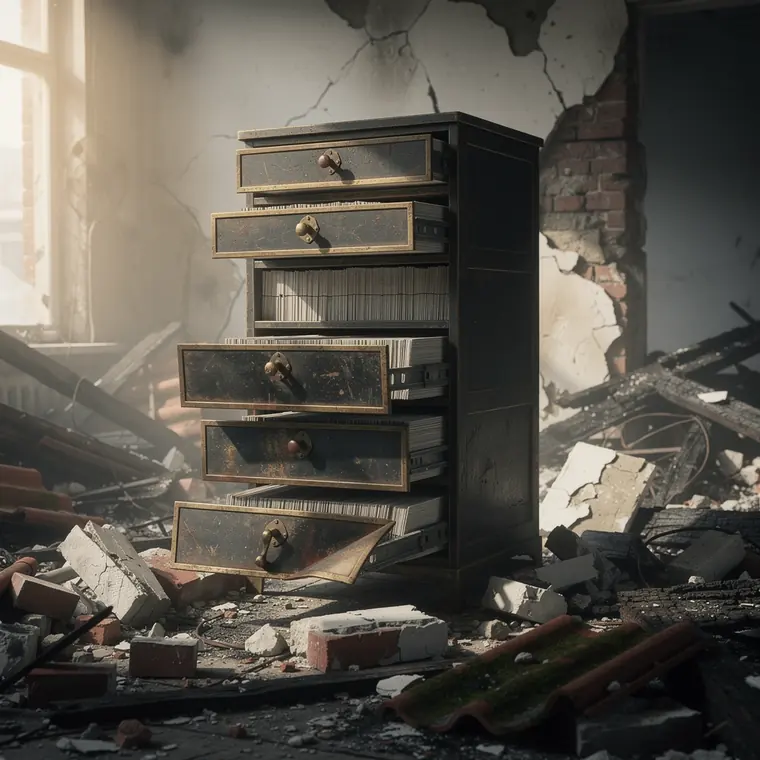
A soot-blackened steel drawer cabinet standing upright in the rubble of a collapsed white town villa in The Hague in the Netherlands on an April afternoon of 1944, the cabinet about one and a half metres tall and one metre wide, six tiers of deep drawers, several drawers pulled out and hanging askew, inside them densely packed bundles of small cards standing upright, their edges singed brown, seen edge-on as thin grey lines, around the cabinet broken brick, chunks of white plaster, charred roof beams, scattered roof tiles, behind it bare wall remnants of pale plaster, flat hazy daylight from the left, the ruin lies still and deserted.
- What it was used for
- The Villa Kleykamp in The Hague housed the duplicate copy of the Dutch identity documents. Andere Tijden writes that the building had been the seat of the central population register since 1941 and held the receipts for the persoonsbewijzen - one copy each with fingerprint and photograph, with which the occupiers could check forged cards. The Dutch resistance asked the government in London to have the house bombed. The request went through the liaison officer Pierre Louis d'Aulnis de Bourouill. On 11 April 1944, shortly before three in the afternoon, six Royal Air Force Mosquito fighter-bombers attacked. The building was completely destroyed and the receipts swirled through the neighbourhood.
- What was new
- Technically there was nothing new about the house. What was new was what the raid said about the file: the countercheck a Dutch civil servant had built was worth a daylight attack on a villa in a residential street to the Allies. Less was achieved than hoped. According to TracesOfWar and Andere Tijden not even half the receipts were destroyed, because many survived in archive and fireproof cabinets. The Germans then moved them elsewhere. The dead, by contrast, were almost entirely the office's own staff. The motive is still disputed. The liaison officer Cornelis Moolenburgh said in 1975 that the only aim of the daylight attack was to destroy as many registers as possible. The amateur historian Henk Kuilder argues against this that the Dutch government wanted to eliminate the whole system, officials included. The NIOD does not doubt the motives but asks whether the number of victims was a justifiable price. After the war d'Aulnis acknowledged his share of responsibility for the deaths.
What the sources leave open: The death toll is disputed. TracesOfWar gives 59. Andere Tijden gives 62 in one place and 59 in another. Omroep West gives 65 dead, 59 of them officials. The squadron number, 613 Squadron, appears only in TracesOfWar. Andere Tijden names six Mosquitos from Swanton Morley airfield but no squadron.