FOSDIC
1960 · Optical Film Scanner · Work 712 of 1,871
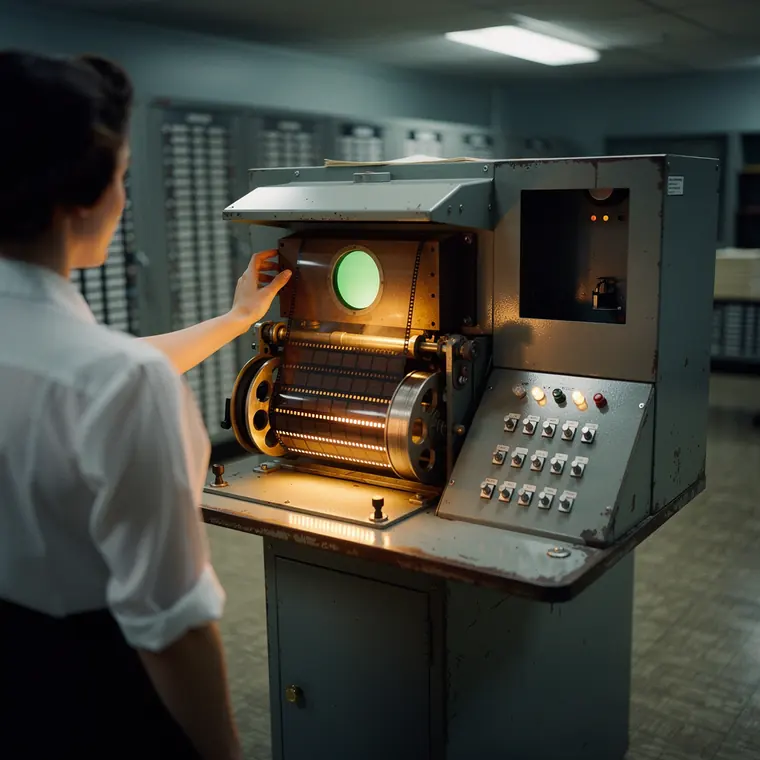
A film scanning machine of 1960 in a government data processing hall in Suitland, Maryland, a cabinet of grey painted steel about one metre eighty high, with a microfilm transport set into its front, two metal reels, sixteen-millimetre negative film threaded between them, the film a dark strip with rows of tiny bright dots running past a small round tube window glowing pale green under a steel hood, beside it a sloping desk panel with rows of plain toggle switches and small pilot lamps, a woman technician seen from behind, her shoulder in a white blouse and her hand on the upper reel, linoleum floor, magnetic tape cabinets soft in focus behind, cool fluorescent light.
- What it was used for
- The Film Optical Sensing Device for Input to Computers was a reader built for the US Census Bureau that scanned microfilm of hand-marked forms and converted the markings into electronic form. According to the Census Bureau it was developed by National Bureau of Standards scientists together with the Bureau's own engineers, the first version being completed in 1954. In 1960 the completed forms were photographed onto microfilm, where the circles shaded in pencil appeared as light dots. FOSDIC III read those dots and wrote them as computer code onto magnetic tape. On speed, the Census Bureau gives 3,000 items per minute for 1960, while NIST says the first FOSDIC translated up to 10 million answer positions per hour. Later versions served the censuses of 1970, 1980 and 1990; NIST counts 12 versions between 1954 and 1998.
- What was new
- What was new was that the forms were designed for the machine from the outset. The Census Bureau's own 2022 working paper states that the 1960 forms were laid out for machine-oriented digital processing from the start, whereas earlier forms were filled in almost entirely by hand and then punched onto cards by clerks. The price appears in the same paper: because the film carried the answers, large quantities of paper could be destroyed. The microfilm is therefore the original. The National Archives are now digitising about 41,000 rolls of 1960 census microfilm - by their own account more than six times as many as for 1950 - and will not release the records until April 2032.
What the sources leave open: The Census pages contradict each other on the 1960 procedure: “About the 1960 Census” has respondents mark the circles; the FOSDIC page and the 2022 working paper state that enumerators or staff transferred the answers to separate FOSDIC forms (“Enumerators transferred data collected on questionnaires to a ‘FOSDIC-readable schedule’”). The speed figures (3,000 “items” per minute; 10 million “answer positions” per hour) measure different things.