The Last Printout
1963 · High-Speed Line Printer · Work 714 of 1,871
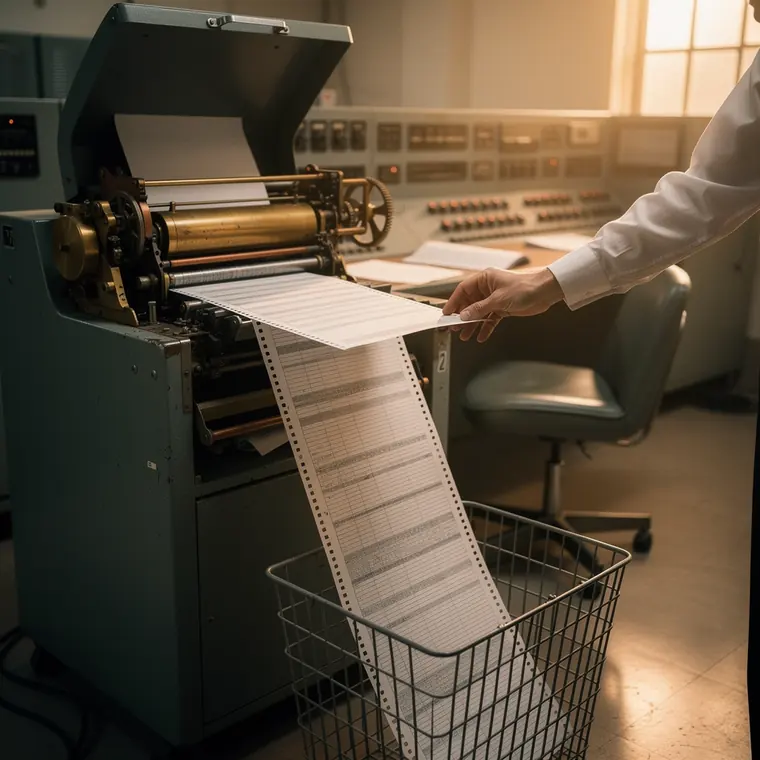
A high-speed line printer in a government computing hall in Suitland, Maryland, on an October afternoon of 1963, a waist-high cabinet of grey painted steel about one metre high, its hood raised, from the paper slot a last web of continuous fanfold paper twenty-eight centimetres wide with sprocket-hole margins hanging at a steep angle down into a wire waste-paper basket, the lines on the paper showing only as fine grey horizontal bands, a man's hand in a white shirt cuff parting the final sheet along its perforation, behind it soft in focus the long console with its lamps dark and a vacant swivel chair, low amber sunlight from windows on the right.
- What it was used for
- The sheet is the last page of the last program printed by the Census Bureau's UNIVAC I; the National Museum of American History dates the run to 3 October 1963. The Bureau signed the contract for the machine on 31 March 1951 and the dedication took place on 14 June 1951 at the Eckert-Mauchly laboratory in Philadelphia. The machine tabulated parts of the 1950 population census and the whole of the 1954 economic census; through the 1950s it handled weighting and sampling for monthly economic surveys. The Bureau bought a second UNIVAC I in the mid-1950s and two UNIVAC 1105 machines for the 1960 census.
- What was new
- What is demonstrably new is not a single computing step but the scope: according to the Census Bureau the entire 1954 economic census ran on this machine, whereas the Bureau had counted with punched-card equipment since 1890. The barb is the term. By the time the sheet came off the printer in 1963 the 1960 census had long since been run on two UNIVAC 1105 machines and with FOSDIC; TIME writes that the machine was retired "twelve years later" and given to the Smithsonian. The catalogue also contradicts itself: the object is listed as an "Autographed Example", while its description reads "They are not signed."