The Personenkennzahl
1970 · Personal Identification Number · Work 716 of 1,871
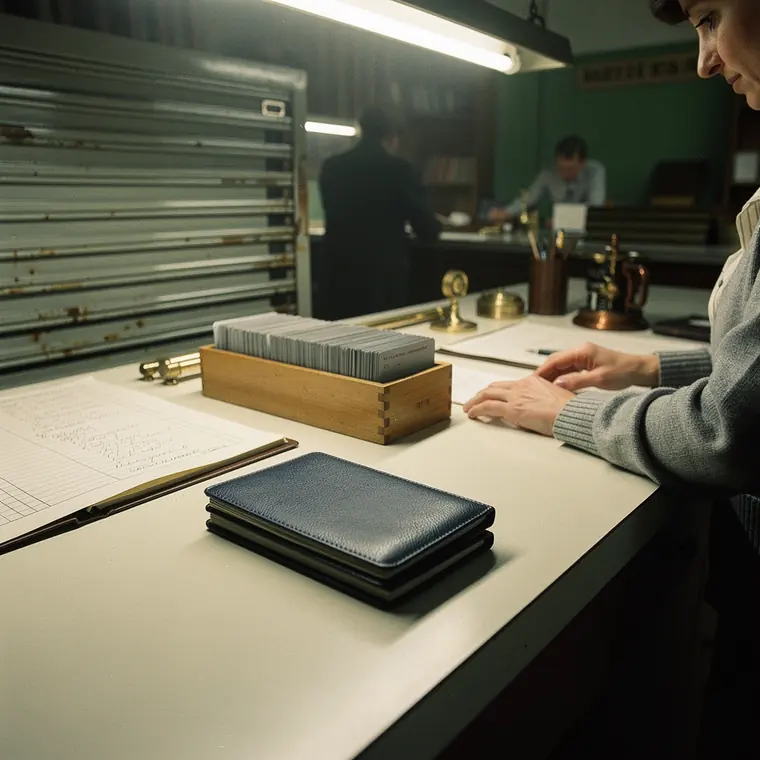
A stack of closed identity booklets on the counter of a residents' registration office in a district town in Saxony in 1970, each booklet about ten and a half by seven and a half centimetres, stiff imitation leather with rounded corners, lying back cover up, plain dark blue, squared in a neat pile, and beside them a wooden box of grey index cards seen edge-on as fine lines, a pale laminate counter top, the hands of a woman clerk in grey cardigan sleeves seen from the side, a roller-shutter filing cabinet blurred behind, flat light from fluorescent tubes.
- What it was used for
- The GDR's Personenkennzahl, a number for the unique identification of every citizen, was introduced step by step from 1970 by the Ministry of the Interior, according to the Leipzig memorial Museum in der "Runden Ecke". It had 12 digits: 1 to 6 the date of birth, 7 the century and sex - 2 and 3 for up to 1899, 4 and 5 for 1900 to 1999, even digits male, odd female -, 8 to 11 a key for the issuing office, 12 a check digit. The Bundesarchiv describes it as the primary key of the Personendatenbank run by the Büro für Personendaten from 1 January 1984: over 60 data fields on everyone with a main residence in the country, including exit applications, travel restrictions and flags for entries in the central criminal register. The MfS had full access from the start through a ZAIG working group with 16 posts.
- What was new
- What was new was not the number but that it was actually imposed. In the same year that the GDR began introducing its number, the Federal government was also planning a twelve-digit identifier. Bundestag paper VI/598 of 1 April 1970, the Interior Minister's answer to a parliamentary question, describes a federal Personenkennzeichen made of date of birth, sex, a four-digit serial and a check digit; the government thought allocation possible in 1973. In the East the number came, in the West it did not: the Humanistische Union writes that the Bundestag's legal committee stopped the introduction in 1976, citing the 1969 Mikrozensus ruling. The barb: the number outlived the state. According to the Bundesarchiv the Personendatenbank became the Zentrales Einwohnerregister in 1990/91, kept the PKZ as its key and was dissolved only at the end of 1992.