The Census Judgment
1983 · Informational Self-Determination · Work 717 of 1,871
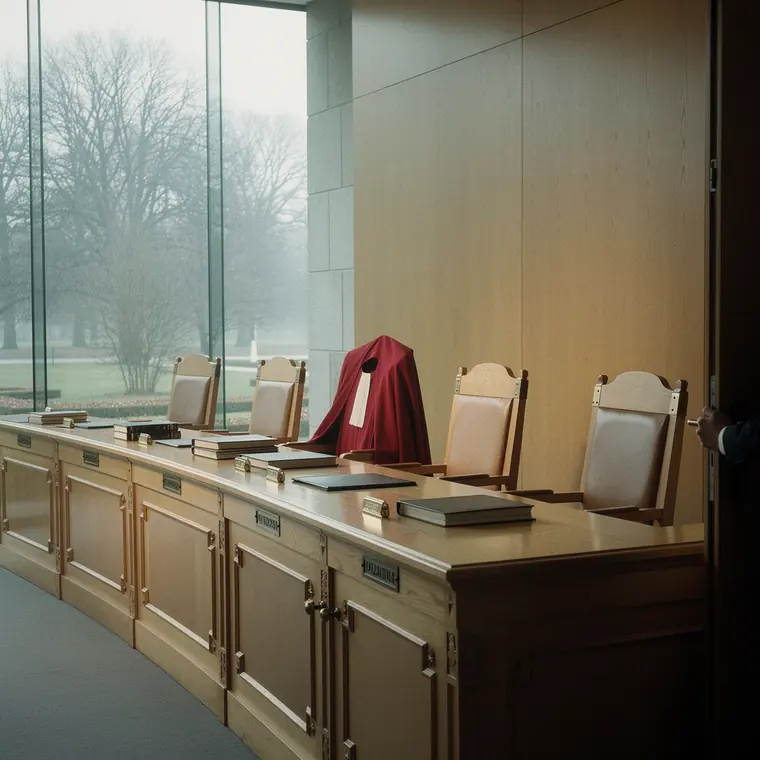
The vacant judges' bench of a constitutional courtroom in Karlsruhe on a grey winter morning of 1983, a long gently curved bench of pale wood, behind it eight high-backed chairs, at each place a closed grey file folder lying flat, over the back of one chair a scarlet robe with a white jabot, behind the bench a plain pale wooden wall panel, to the side a floor-to-ceiling glass wall, outside it the bare winter trees of a palace garden, at the right edge of the frame a single hand in a dark suit sleeve closing the hall door, the room still and deserted, soft even daylight through the glass.
- What it was used for
- The judgment of the First Senate of the Federal Constitutional Court of 15 December 1983, case 1 BvR 209/83 and others, printed as BVerfGE 65, 1. It decided constitutional complaints against the 1983 census act. According to the Bundeszentrale für politische Bildung the court had stopped the census planned for 27 April 1983 by interim order about 2 weeks beforehand; in the judgment it held the transfer rules of § 9 paras 1 to 3 incompatible with the general right of personality, while transfer for scientific purposes under § 9 para 4 survived. The comparison with the population registers was therefore inadmissible.
- What was new
- What was new was the reach. The court coined the right to informational self-determination: the individual's authority to decide himself on the disclosure and use of his personal data. The protection also covered basic data such as name and address: under the conditions of automatic data processing, the court said, there was no longer any 'trivial' item of data. From that followed a rule for the procedure, not merely a sentence about basic rights: according to the Bavarian statistical office the court required the identifying items to be deleted at the earliest possible moment and, until then, kept separate from the other answers - the requirement of the earliest possible de facto anonymisation. The barb: the court did not forbid the census, it forbade this procedure. The count took place in 1987 with, according to the Federal Statistical Office, 99 per cent participation: 61.08 million residents, 76,700 fewer than assumed.
What the sources leave open: Gößl calls the right to informational self-determination „einen neuen Namen, einen neuen Begriff für die bereits vorher unumstrittene Annahme“ (a new name, a new term for an assumption already undisputed before); the novelty of the ruling is thus a matter of emphasis.