The BBC Domesday Project
1986 · Interactive Videodisc System · Work 718 of 1,871
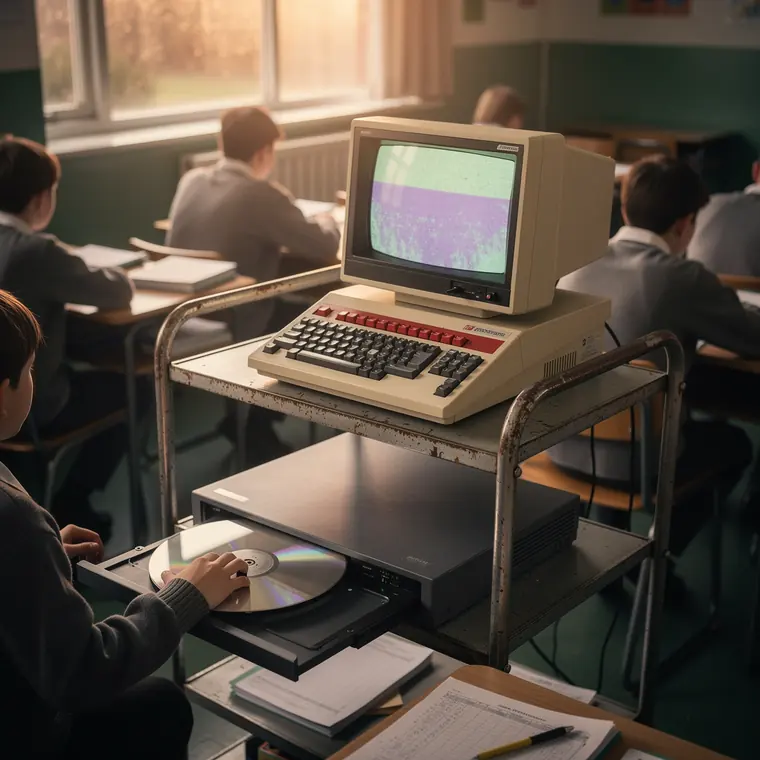
A school videodisc computer system of 1986 on a steel trolley in a classroom of a comprehensive school in England in November, on the lower shelf a wide flat videodisc player in dark anthracite grey, its drawer half extended and holding a mirror-silver disc thirty centimetres across with a rainbow sheen, on the upper shelf a flat wedge-shaped cream microcomputer with black keys and a row of red function keys, on top a cube-shaped monitor, its screen a soft glow of colour, beside the keyboard a small cream trackball box with three buttons, a child's hand resting on the ball, pupils in grey school jumpers seen from behind, wooden desks, low sunlight through steel-framed windows.
- What it was used for
- An enquiry system of 2 videodiscs and a playback station, published in November 1986. The Science Museum holds the Philips LaserVision player VP415/05 of 1986 with the National and Community discs made by BBC Enterprises. With it went a BBC Master with co-processor, a monitor and a trackerball. According to the paper by David Rhind and Stan Openshaw each disc side held 54,000 images, and the discs held 24,000 Ordnance Survey topographic maps, 21,000 spatial data sets and 30 million words of text; the Community disc divided Britain into blocks of 4 by 3 kilometres carrying, as the Ariadne account states, up to 20 text screens and up to 7 pictures each. The schools' land-use survey covered over 100,000 one-kilometre grid squares.
- What was new
- What was new was the mixture on one carrier: Rhind and Openshaw give up to 324 megabytes of digital data per disc side in the LV-ROM format alongside the analogue video picture, so that maps, statistics, photographs and film were reachable from a single query. They put it in their title: a nation-wide spatial information system for $4448, the price schools paid at launch. The barb is that same price. The Science Museum writes that the necessary BBC Master cost around £5,000, which put the system out of reach for many, and that only about 1,000 were sold; according to the Ariadne account the project was a success in every way except its sales. The survey, in which according to the Science Museum over 1 million people and over 10,000 schools took part - Rhind and Openshaw speak of 14,000 schools - ended up on a machine almost nobody had.
Further reading
- Philips LaserVision Player VP415/05 with BBC Domesday discs, 1986 (2008-39), Science Museum Group Collection
- David Rhind / Stan Openshaw, The BBC Domesday System: A Nation-wide CIS for $4448, Auto-Carto 8 Proceedings
- Jeffrey Darlington / Andy Finney / Adrian Pearce, Domesday Redux: The Rescue of the BBC Domesday Project Videodiscs, Ariadne 36, 30.07.2003