Indicted and Arrested
1894 · The Revolutionaries · Work 720 of 1,871
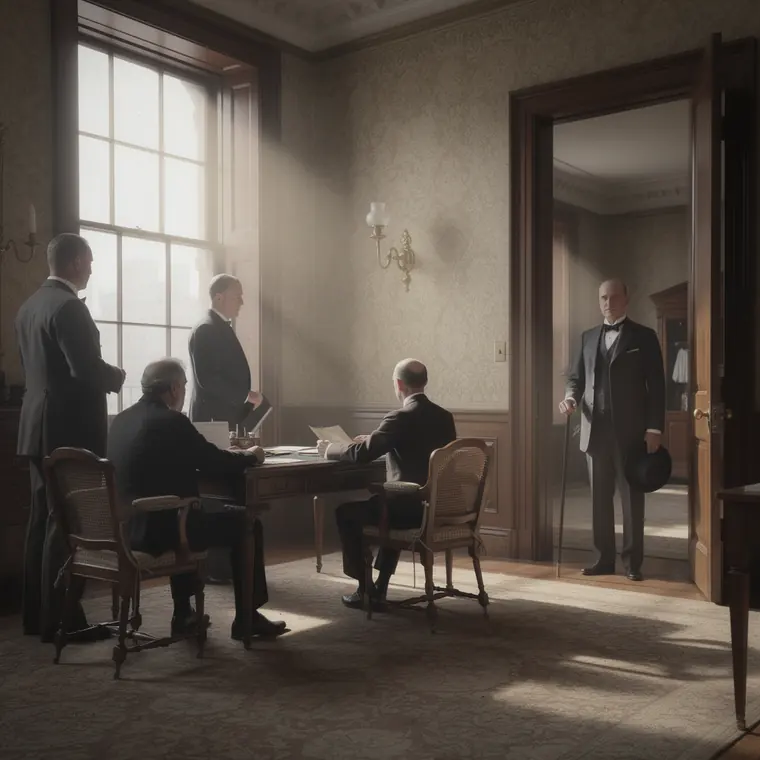
The outer room of a suite at the Leland Hotel, Chicago, used as an office, late afternoon of 10 July 1894, soft daylight from a tall sash window at the left, patterned wallpaper, a high plaster ceiling, a brass gas bracket beside the door, a slant-topped writing desk heaped with loose sheets of plain paper, cane-seated chairs, an open door to the corridor at the far left and an open door to the inner room at the right, and standing in that inner doorway, in the right third of the picture, facing the camera with his face fully lit, the man, a tall clean-shaven American of thirty-eight with a high balding forehead, in a dark suit with waistcoat and white collar, a black felt hat in one hand and a walking stick in the other, while in the corridor doorway at the far left stands a heavy-set man in a grey summer suit and straw boater in half- shadow, behind him a man in a brown suit and derby seen from behind, a man in shirtsleeves and grey waistcoat seated at the desk with his back to the camera, and a fourth in a checked coat at the window in profile.
- Who
- Eugene V. Debs (1855–1926) of Terre Haute, Indiana, was one of the best-known trade unionists and socialists in the United States. He left school at fourteen, worked as a painter in the railroad yards and from 1870 worked as a locomotive fireman. In 1875 he helped found the local lodge of the locomotive firemen in his town. In 1893 he set up the American Railway Union in Chicago, a union for every railroad trade, though only for white workers. After the Pullman strike of 1894 he served six months in jail and there began to turn to socialism. Between 1900 and 1920 he ran five times for president on the Socialist ticket. For speaking out publicly against the First World War in 1918 he was sentenced to ten years in prison; from his cell he won nearly a million votes in 1920. President Harding released him at Christmas 1921. His home in Terre Haute is now a museum.
- The moment
- On 11 May 1894 the workers at the Pullman car works near Chicago went on strike, against the advice of the union leadership. From 26 June the members of the American Railway Union, some 150,000 men, refused to move trains carrying Pullman cars, and rail traffic across the country stalled. Debs directed the boycott by telegram. On 2 July a federal court enjoined him from obstructing the mails and commerce, and on 3 July President Cleveland ordered federal troops into Chicago; fighting in the rail yards left dozens dead. On the afternoon of 10 July a grand jury indicted Debs and three other union officers for conspiracy against the mails. Marshal Arnold found him at the Leland Hotel, in the outer room Debs used as an office. Debs stepped into the inner room, came back, reached for his hat and walking stick and said: "I have been indicted and arrested." Then he went along; shortly before five the marshal brought him in to the district attorney. By evening he was free on $10,000 bail. The picture shows the moment in the doorway.
- The other side
- That afternoon the machine is in the room only as a wire. The grand jury relied in part on Debs's telegrams; the Chicago manager of Western Union had to hand them over under subpoena, and the company's objection that they were privileged was overruled. At the same time officers took papers and Debs's unopened mail from the union headquarters in the Ashland Block. "It seems like the act of the czar of Russia," Debs said that evening. In 1895 the Supreme Court unanimously upheld his sentence for contempt; in the National Park Service's judgement the injunction made national strikes effectively illegal.
What the sources leave open: The scene in the hotel is described in a Chicago newspaper dispatch of the same day; no second eyewitness account was found. Of the rooms only an outer room used as an office is recorded; the room in the picture is a typification. The hat and stick are documented, the clothing is not. Debs later gave 7 July as the day of his arrest; the indictment and the newspaper give the 10th. The face follows a photograph of January 1895.
Further reading
Sources
- Eugene V. Debs Foundation: Debs Biography (Lebensdaten, Heizer, ARU, Kandidaturen, Haft 1918–1921, Museum)
- Pullman National Historical Park (NPS): The Strike of 1894 (ARU nur für Weiße, 150.000 Mitglieder, Streik gegen den Rat der Führung, Tote, Folgen der Injunction)
- Federal Judicial Center: The Debs Case (Chronologie 26. Juni bis 27. Mai 1895, Truppen am Seeufer, Espionage Act, 3 Prozent 1920)
- Omaha Daily Bee, 11. Juli 1894, S. 1, „Debs Was Indicted“ (Chicago-Depesche vom 10. Juli)
- Eugene V. Debs: How I Became a Socialist (1902), Marxists Internet Archive
- Eugene V. Debs: Aussage vor der U.S. Strike Commission, August 1894 (Verhaftung und Beschlagnahme „on the 7th of July, as I remember it“)