The Pigeon Post Film
1870 · Microfilm Despatch Projection · Work 723 of 1,871
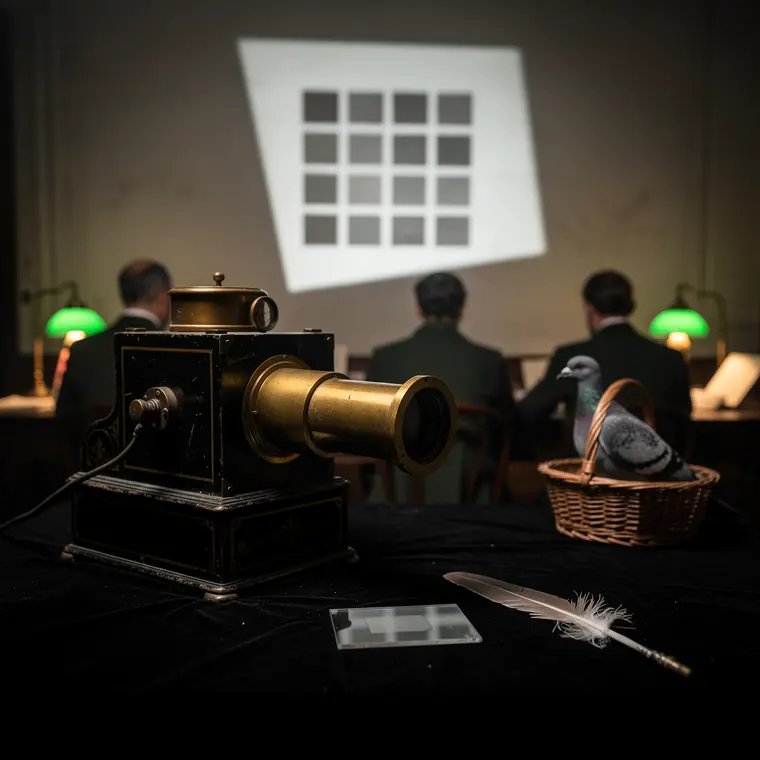
A magic lantern of 1870 on a table in a darkened hall of the central telegraph office in Paris, a box of black japanned sheet metal with a brass lens tube, its cone of light throwing a bright rectangle at a slant onto the whitewashed wall, the rectangle a grid of sixteen small grey panels in four rows of four, soft in focus, in the foreground on black velvet a small glass plate carrying a thin translucent greyish film three centimetres by five, beside it a short cut goose quill, four clerks seen from behind at a long table, oil lamps with green shades, one grey pigeon in a wicker basket.
- What it was used for
- A film of photographically reduced despatches that carrier pigeons took into besieged Paris in 1870/71. René Dagron reduced the despatches photographically. Dagron himself dates his contract with the postmaster general Rampont, signed by the finance minister Picard, to 10 November 1870. According to the University of California library exhibit Dagron left Paris by balloon on 12 November 1870; the balloons were shot at and the equipment in the Daguerre was lost. He reached Tours on 21 November and began work in earnest on 15 December. The reduction was more than 40 diameters; where the photographer Gabriel Blaise had fitted a letterpress page into about 37 by 23 millimetres, Dagron needed about 11 by 6. One film weighed about 0.05 grams and a pigeon carried up to 20. In Paris the film lay between 2 thin glasses and was projected by magic lantern onto a screen, where clerks copied out the text.
- What was new
- Microphotography itself was Dagron's old business - historyofinformation gives his lens method of 1857, a patent of 1860 and a treatise of 1864. An unlimited number of copies had already been possible with the photographic method on paper proposed by the Tours chemist Charles Barreswil; what was new was the light film that made multiple dispatch portable. According to John Douglas Hayhurst's account as reproduced by the Dead Media Project, one official despatch was repeated 35 times and later private ones on average 22 times; one tube from January held 21 films, 6 official and 15 private. The barb: that multiplication was needed because the carrier failed - the copy was the insurance against lost pigeons. And the narrowness remained: Hayhurst counts 1,370 postal orders worth 190,000 francs and about 30,000 messages cut down to yes/no answers, roughly a quarter of all private traffic.
What the sources leave open: Historyofinformation dates the contract to 11 November 1870, Dagron himself to 10 November. The often-cited fee of 15 francs per 1,000 characters appears there only in a quotation from Wikipedia.
Further reading
- The Pigeon Post into Paris 1870-1871 - Southern Regional Library Facility, University of California, Ausstellung
- Dead Media Project, Working Note 4.4 (nach John Douglas Hayhurst, The Pigeon Post into Paris 1870-1871, 1970)
- René Dagron Operates the Pigeon Post into Paris, HistoryofInformation.com
- René Dagron, La poste par pigeons voyageurs. Souvenir du siège de Paris (1871), Project Gutenberg