The Daguin Machine
1884 · Hand-Lever Cancelling Machine · Work 725 of 1,871
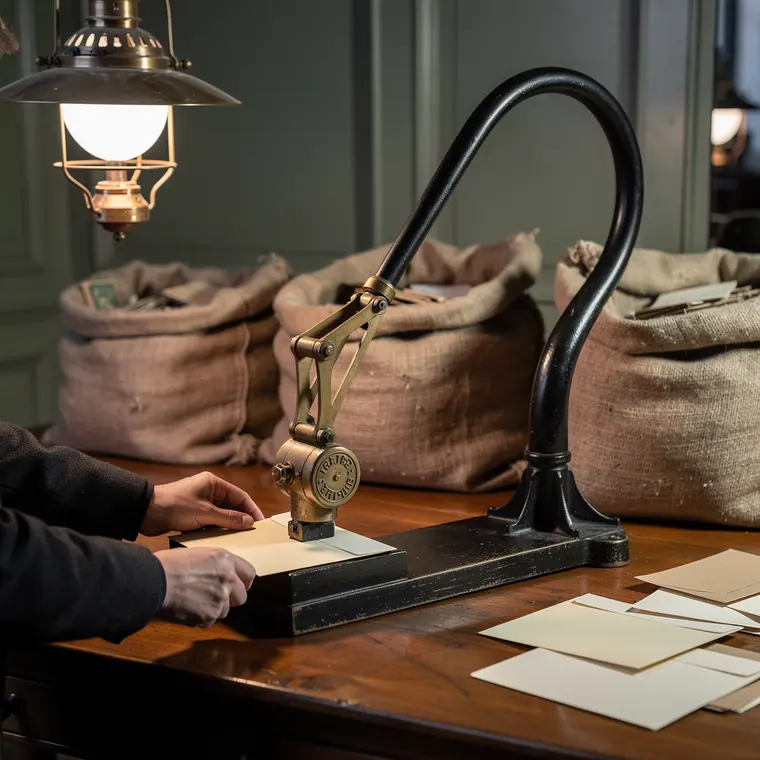
A hand-lever cancelling machine of 1884 on a long oak table in the departure office of the post in Paris, a flat black-painted wooden base board seventy-three centimetres long, on its right a splayed iron foot from which a black swan-necked iron arm swings in a high arc to the left, forty-three centimetres tall, at the end of the arm a jointed linkage of bright steel and brass levers carrying the round marking head, its face turned down, one hand in a dark sleeve on the lever, the other sliding a plain envelope under the head, seen edge-on, open sacks of coarse linen behind, a gas lamp with a milk-glass globe above.
- What it was used for
- A hand-operated cancelling machine in French post offices. The clerk fed in letter after letter and worked an articulated arm carrying 2 date stamps: one cancelled the stamp, the other printed a legible date. A tilting mechanism re-inked the two copper stamps automatically each time they rose. According to multicollection.fr, it raised the clerks' output from 1,000 to 3,000 letters per hour. The first machine entered service on 5 June 1884 at the main Paris post office.
- What was new
- What was new was not the double strike - since March 1876 clerks had had to put 2 date stamps on every letter - but that cancellation and legible date fell in one pull yet remained separate dies, which is why Daguin impressions appear as a pair. Daguin filed patent number 143 668 on 12 September 1881. The barb is duration. Eugène Daguin died in 1888 aged 39, 4 years after his machine entered service. The machine stayed: multicollection.fr writes that it remained in service until 1967 and names one of the last known Daguin machines, at the office of L'Epine in the Marne, whose last identified strike dates from 28 July 1967. That is 83 years for a hand-fed device.
What the sources leave open: philatelie-pour-tous.fr is no longer reachable and relied on Wikipedia; details found only there (provincial offices from late September 1884, 500 machines in 1930, a patent in June 1881) are not used.