The Receipt Card
1891 · Insurance Contribution Card · Work 726 of 1,871
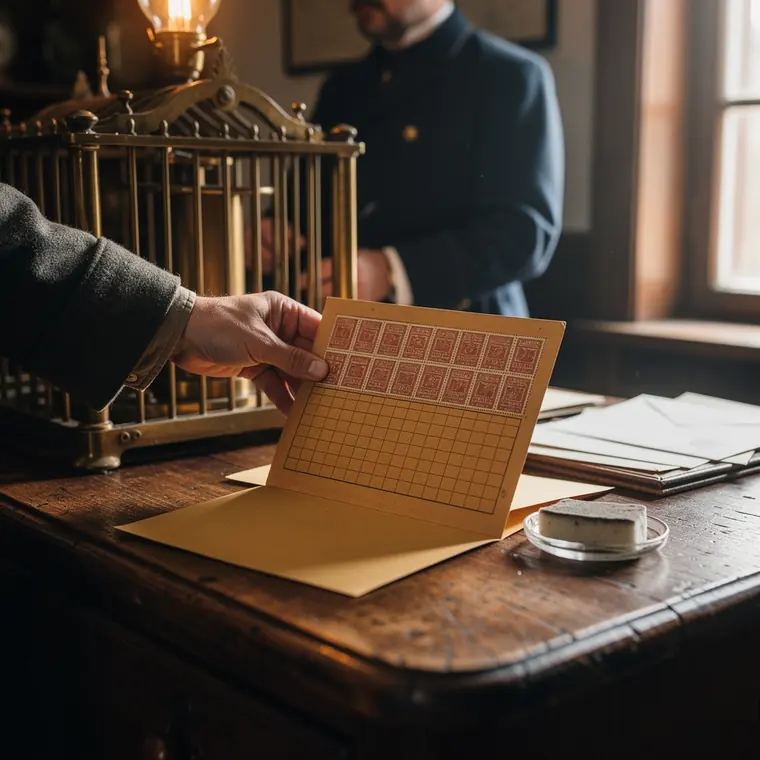
An opened folded pasteboard card of 1891 lying at a flat angle on the worn oak counter board of a small post office in Saxony, the card of folded yellowish brown pasteboard, opened twenty-one centimetres by fifteen, soft in focus, its inner side a plain grid of small ruled fields from edge to edge, the upper half filled with rows of small gummed paper squares of plain reddish colour, beside it a moistening sponge in a glass dish, a worker's hand in a coarse grey woollen sleeve pushing the card toward the brass grille, behind the grille the postal clerk in a dark blue coat, gaslight from above and daylight from the door on the right.
- What it was used for
- The Quittungskarte of the German invalidity and old-age insurance. The chronicle of the Deutsche Rentenversicherung gives the law of 22 June 1889 and its entry into force on 1 January 1891. Contributions were paid as weekly stamps bought at the post office and glued into the receipt card, which served as proof of payment; the rate was about 1.7 per cent and the highest class IV applied above 850 marks of annual earnings. In 1890, a year before the law took effect, 31 insurance institutions were set up. Full cards went back to the regional insurance offices, according to the Arolsen Archives; until 28 June 1942 civilian forced labourers bought the stamps and employers glued them in, and from July 1942 employers withheld the share from wages.
- What was new
- What was new was not welfare but the proof: entitlement hung on stamps on a card, and the stamps were sold by the post office, which thereby became the cash desk of a social insurance. The barb has 2 halves. The weekly stamp persisted: the pension insurance chronicle records the abolition of weekly stamps in the workers' scheme only in 1957 and of the last contribution stamps in 1976, 85 years after the start. And the card outlived its purpose: according to the Arolsen Archives, firms, authorities and insurers had to hand over the receipt cards in the foreigner tracing campaign, because the cards made it possible to clarify their holders' fates - forced labourers had to pay at least 26 weeks of contributions a year, yet rarely received benefits and acquired no German pension rights.