The Check Protector
1901 · Amount Protection Device · Work 728 of 1,871
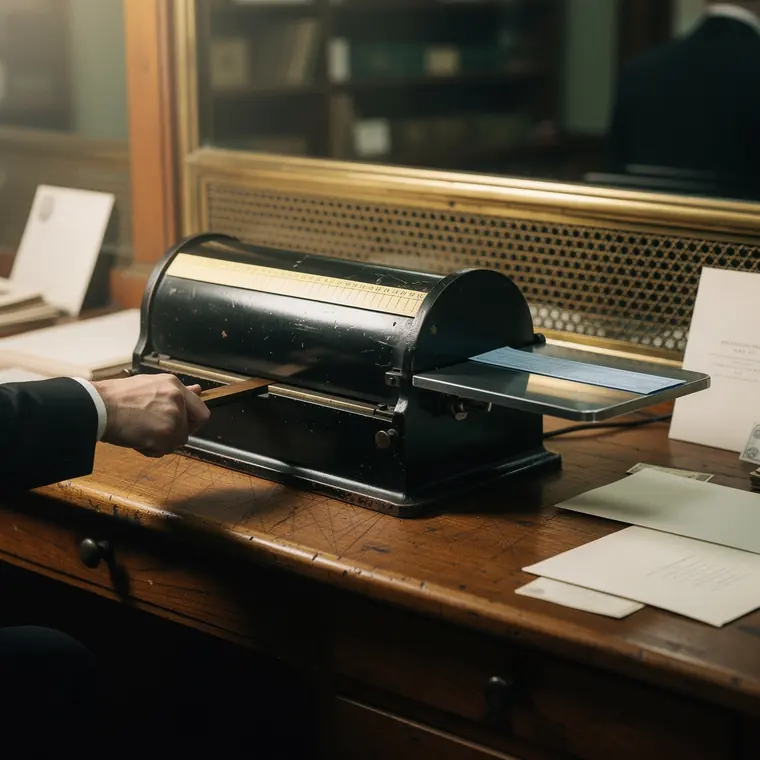
A protective amount-marking machine of 1901 on the oak table behind the money order window of a post office in the United States, a long flat body of black enamelled cast iron forty centimetres long, twenty-one wide and eleven high, with a rounded barrel-shaped back, along its top a narrow cream-yellow scale strip with fine graduation marks, at its side a rectangular bright metal table on which a narrow slip of pale blue paper lies flat, seen edge-on, at the front left a short lever, one hand in a dark sleeve on the lever, behind it the brass grille of the counter window, gaslight and daylight from the left.
- What it was used for
- Check protectors were meant to stop a written amount from being raised afterwards. The methods ranged from punching the figures out, through embossing them into the paper, to forcing ink into its fibres. The Early Office Museum records for 1901 the Pan-American Check Protector of J. B. Benson, Pittsburgh, and beside it a row of small devices: Merritt's Check Punch at 50 cents in 1903/04, the embossing Stewart Check Protector at 5 dollars in 1906, the Grabler Check Protector at 25 cents. The same source notes that between 1870 and 1899 comparatively few non-government checks carried any mechanical protection at all.
- What was new
- The mechanism of the 1901 device was not new: the Early Office Museum states that the mechanical part of the Pan-American is the same as that of the Buffalo Check Protector sold by R. B. Carsley & Co. of Chicago back in the 1870s - patented 1871, exhibited 1873 - and that only the metal differs. The name changed, the mechanism did not. As the earliest evidence of mechanical check protection the same source names US patent 97,344 of 1869 to Max Emanuel Berolzheimer, which punched holes in pre-printed checks; whether it was ever sold is unknown. The first machine on the principle of forcing the amount into the paper fibre is dated there, after Leffingwell, to 1899 (G. W. Todd).