The Home Savings Box
1904 · Locked Steel Savings Box · Work 729 of 1,871
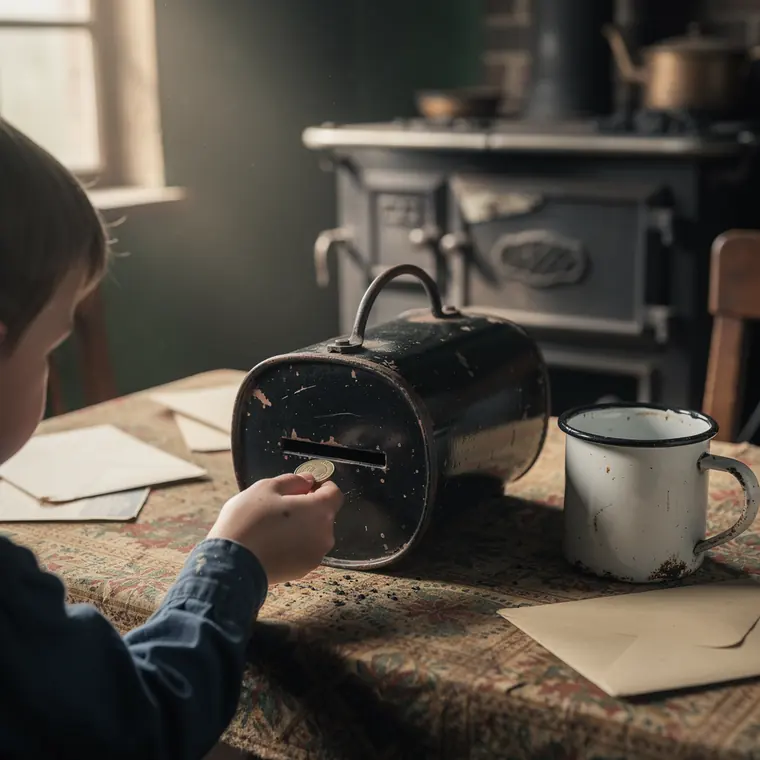
A small home savings box of 1904 on the oilcloth of a kitchen table in a miner's kitchen in the Ruhr coalfield, a squat box of thick sheet steel on an oval ground plan, nine centimetres wide, five deep and nine and a half high, enamelled black, the enamel chipped showing rust-brown metal, a flat riveted lid with two short posts carrying a round wire bail, facing the lens the rounded narrow end with a horizontal coin slot, a child's hand in a blue cotton sleeve pushing a coin seen edge-on into the slot, beside it a white enamel mug, daylight from a window on the left, a black coal range behind.
- What it was used for
- The home savings box was a locked tin or brass box lent by a savings bank to small savers. It stayed the bank's property, carried a stamped number, and only the collecting cashiers held the matching key; movable balls in the slot stopped the money being shaken out again. The cashier came to the house, opened the box and credited the contents to the savings book; before the First World War he was paid 3 pfennig per weekly visit and 15 pfennig for a new customer. The Kreissparkasse Köln names domestic servants, factory workers and day labourers among the regular savers who received savings bonuses, and for Dresden in 1908 some 4,500 boxes on loan, 5,200 emptyings and 133,000 marks - about 26 marks per box.
- What was new
- What was new was not saving at home but that the bank kept the key: the saver could pay in but not take out. Who did it first is disputed. The Sparkassengeschichtsblog dates the home-savings principle, after Pohl (2005), as part of German small savings since 1904 and traces it to the American banker Walter Francis Burns in the 1890s; the Kreissparkasse Köln gives the same name only as "Burns" around 1890 and beside it the Danish inventor Jacob Christian Ellehammer, said to have designed a brass model for a Danish bank around 1900 - fee 3,000 kroner, weight over 1 kilogram. The price of compulsion was administration: around 1910 more than 50 models circulated in Germany, and later the boxes were issued without a pledge because administering them had become too costly.