The Stamp Vending Machine
1905 · Coin-Operated Stamp Dispenser · Work 730 of 1,871
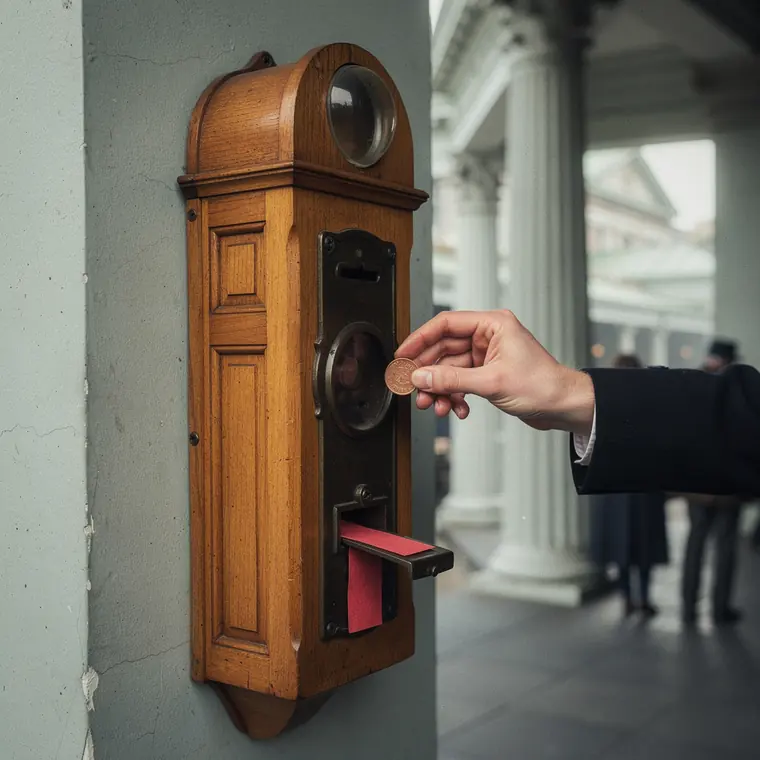
A coin-operated vending machine of 1905 fixed to the plastered wall under the columned portico of the general post office in Wellington, a narrow upright cabinet of honey-coloured varnished oak seventy-two centimetres high and thirty-two wide, with panelled sides, on its front a tall narrow plate of dark cast metal with a coin slot at the top, a delivery slot below, on top an arched wooden piece holding a round glazed disc, plain, a hand in a dark sleeve bringing a copper coin seen edge-on to the slot, from the lower slot a short end of a narrow red paper strip, grey harbour light from the left.
- What it was used for
- A coin-in-the-slot machine that issued single postage stamps from a roll. It was built by Robert James Dickie, an employee of the New Zealand Post Office, and the photographer John Henry Brown, both of Wellington. The stamps sat in the machine as a roll; after a penny went into the slot, one stamp was delivered through an opening. Public trial began, according to the Encyclopaedia of New Zealand, on 15 June 1905; the first permanent installation followed in 1909, after step-by-step improvement.
- What was new
- The stamp vending machine as an idea was not new: the first patent for one using rolls of stamps was filed by Constant F. De Redon in the US on 16 July 1888. The machine needed stamps in coils, not sheets. GB Stamp Rolls records that British machines were at first supplied only with ½d and 1d coils, that a single-emitter counter machine at Battersea Rise in 1949 took a coil of 1,920 stamps at 2½d, and that sales of ½d stamps from machines ended in 1966. The same source lists the Dickie-Brown machine as the forerunner, successfully tested by the British Post Office, with a demonstration version by Dickie of 1906. The barb: the British production machines from 1911 were built by BSTAD, later HTA, Brecknell and Associated Automation - not by the inventors. Between the 1905 trial and the permanent installation lay 4 years of rework.