The Postage Meter
1920 · Sealed Postage Meter · Work 732 of 1,871
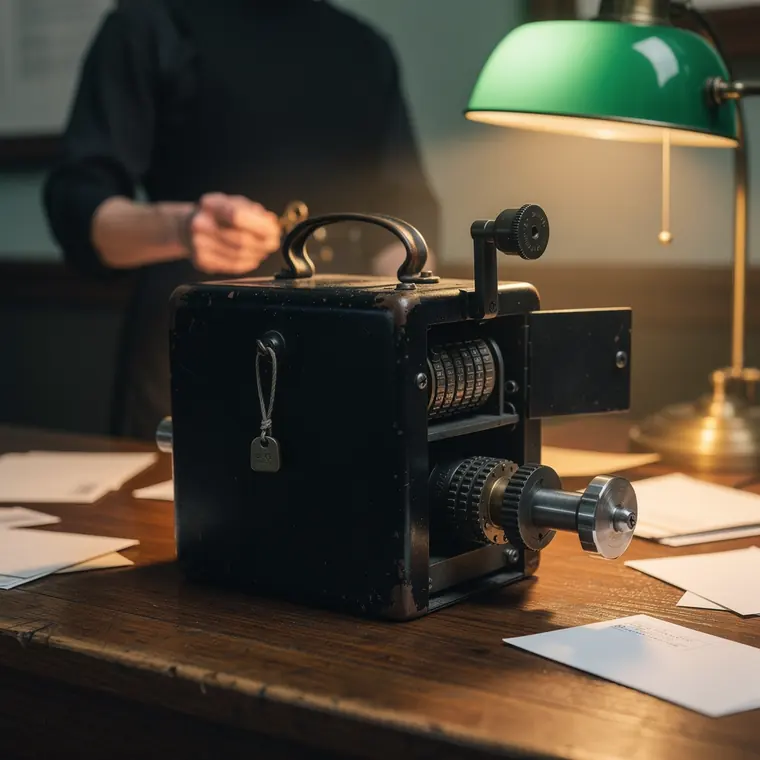
The meter of a postage franking machine of 1920 on an oak table behind the counter of a post office in Connecticut, a compact box of black enamelled metal with rounded corners, twenty-one centimetres wide, sixteen high and eleven deep, on top a carrying handle, on one side two small doors one above the other, the upper one open onto a row of narrow counting wheels in deep shadow, at one end a short upright shaft with a round steel printing drum, a small lead seal on twisted wire, a postal clerk seen from behind in black sleeve protectors holding a small key, warm light from a green-shaded lamp.
- What it was used for
- The Pitney-Bowes Model M franked business mail without stamps. The post office set the credit, then locked and sealed the machine; from then on it printed postage and cancellation in one impression, carrying the customer's licence number, the meter's register number and the amount, with place, date and time alongside. Two registers did the accounting: an ascending one totalling all postage printed, inaccessible even to postal staff, and a descending one showing the credit left. When that ran out the machine locked itself until the post office reset it. Only licensed mailers could use it, and the machine was limited to a single value with fixed printing dies.
- What was new
- Metering by machine was not new: ASME lists forerunners from Carle Bushe (patent 1884, never used) through Wolf and Scott (1898) to a Norwegian trial (1903, dropped after 2 years), and Arthur Pitney's own patent is dated 14 October 1902. What was new was the construction the Post Office finally approved: the Model M separated the register from the printing die, keeping dirt and caked ink away from the impression, and tied the seal to 2 registers; the automatic lockout was, per ETHW, "essential to prevent thefts". The barb: the Post Office moved the accounting of its own postage into private offices and kept the seal and the resetting. The Post Office Department approved the indicia design on 1 September 1920; first commercial use was on 16 November 1920 in Stamford, Connecticut.